**FOR RESEARCH USE ONLY. NOT INTENDED FOR DIAGNOSTIC OR THERAPEUTIC USE.**
INFORMATION IN THIS DOCUMENT IS SUBJECT TO CHANGE WITHOUT NOTICE.
Lexogen does not assume any responsibility for errors that may appear in this document.
**仅供研究使用。不用于诊断或治疗目的。**
本文件中的信息可能会在不另行通知的情况下发生变化。
Lexogen 对本文件中可能出现的错误不承担任何责任。
**PATENTS AND TRADEMARKS**
The SLAMseq kits are covered by issued and/or pending patents. SLAMseq is a trademark of the Institute of Molecular Biotechnology GmbH (IMBA). Lexogen is a registered trademark (EU, CH, US, CN, AU, NO, BR). TRIzol® is a registered trademark of Molecular Research Center Inc., CellTiter-Glo® is a registered trademark of Promega Corporation, SpeedVac is a trademark of Savant Instruments Inc., Synergy is a trademark of BioTek Instruments Inc., Discovery is a registered trademark of Sigma-Aldrich, and NanoDrop is a registered trademark of Thermo Fisher Scientific, Inc. All other brands and names contained in this user guide are the property of their respective owners. Lexogen does not assume responsibility for patent infringements or violations that may occur with the use of its products.
**专利和商标**
SLAMseq kits 受已授予和/或待批准的专利保护。SLAMseq 是 Institute of Molecular Biotechnology GmbH (IMBA) 的商标。Lexogen 是一个注册商标 (EU, CH, US, CN, AU, NO, BR)。TRIzol® 是 Molecular Research Center Inc. 的注册商标,CellTiter-Glo® 是 Promega Corporation 的注册商标,SpeedVac 是 Savant Instruments Inc. 的商标,Synergy 是 BioTek Instruments Inc. 的商标,Discovery 是 Sigma-Aldrich 的注册商标,NanoDrop 是 Thermo Fisher Scientific, Inc. 的注册商标。本用户指南中包含的所有其他品牌和名称均属于其各自所有者。Lexogen 对在使用其产品过程中可能发生的专利侵权或违规行为不承担责任。
**LIABILITY AND LIMITED USE LABEL LICENSE: FOR RESEARCH USE ONLY**
This document is proprietary to Lexogen. These kits are intended for use in research and development only. They need to be handled by qualified and experienced personnel to ensure safety and proper use. Lexogen does not assume liability for any damage caused by the improper use or the failure to read and explicitly follow this user guide. Furthermore, Lexogen does not assume warranty for merchantability or suitability of the product for a particular purpose.
The purchase of the product is subject to Lexogen general terms and conditions (www.lexogen.com/terms-and-conditions/) and does not convey the rights to resell, distribute, further sub-license, repackage, or modify the product or any of its components. This document and its content shall not be used or distributed for any other purpose and/or otherwise communicated, disclosed, or reproduced in any way without the prior written consent of Lexogen. For information on purchasing additional rights or a license for use other than research, please contact Lexogen.
Lexogen is committed to providing excellent products. Lexogen warrants that the product performs to the standards described in this user guide up to the expiration date. Should this product fail to meet these standards due to any reason other than misuse, improper handling, or storage, Lexogen will replace the product free of charge or issue a credit for the purchase price. Lexogen does not provide any warranty if product components are replaced with substitutes. Under no circumstances shall the liability of this warranty exceed the purchase price of this product. We reserve the right to change, alter, or modify any product without notice to enhance its performance.
For any publication using the SLAMseq kits, please refer to the individual kit modules accordingly as: SLAMseq Explorer Kit - Cell Viability Titration Module, SLAMseq Explorer Kit - S4U Incorporation Module, SLAMseq Kinetics Kit - Anabolic Kinetics Module, and SLAMseq Kinetics Kit - Catabolic Kinetics Module, or refer simply as Lexogen’s SLAMseq Kits.
SLAMseq Kits are based on methods developed by the Ameres Group at the Institute of Molecular Biotechnology (IMBA) in Vienna, Austria and should be cited as: Herzog VA, et. al., (2017) Thiol-linked alkylation of RNA to assess expression dynamics. Nature Methods, doi: 10.1038/nmeth.4435.
The SLAMseq Kits are used for S4U metabolic labeling and alkylation of RNA, and are intended for use with cultured cells. They are not next generation sequencing (NGS) library prep kits. The SLAMseq Kinetics Kits are designed to be used in conjunction with NGS library preparation for RNA sequencing. Lexogen highly recommends using the QuantSeq 3’ mRNA-Seq V2 Library Prep Kits (Cat. No. 191 - 196). Previous versions of QuantSeq 3’ mRNA-Seq are also compatible. QuantSeq-Flex Library Prep Modules can be used for targeted RNA sequencing approaches (Cat. No. 028, 166). Lexogen’s SLAMseq (Thiol (SH)-Linked Alkylation for Metabolic Sequencing) kit provides a rapid and scalable method to measure newly synthesized (nascent) and existing RNA levels in parallel. The core SLAMseq workflow involves metabolic labeling of RNA using 4-Thiouridine (S4U) and alkylation of incorporated S4U nucleotides (Fig. 1). In short, cell cultures are incubated with media containing S4U. S4U is taken up by the cells and becomes incorporated into newly synthesized RNA instead of uridine, labeling nascent RNA transcripts. After an alkylation step, total RNA can be used for library preparation. Reverse transcriptase introduces a Guanine (G) instead of an Adenine (A) wherever a modified S4U nucleotide is encountered. Nascent transcripts can therefore be distinguished from existing transcripts in an NGS experiment by mapping to a reference genome and identifying Thymine (T) to Cytosine (C) transitions (T > C conversions).
Labeling Sampling Alkylation RT PCR S4U S4UU HO O ON NSH + I O NH2 HH2ON OO ON NS S4U U S4UGU GCT OH OH OH OH A A Cultured Cells RNA +IAA
Figure 1. The SLAMseq workflow. Cultured cells are treated with 4-Thiouridine (S4U) for labeling of nascent RNA (green). Total RNA is purified (sampling), and alkylation of the 4-thiol group is induced by the addition of iodoacetamide (IAA). During library preparation, for example using the QuantSeq 3’ mRNA-Seq Library Prep Kit, the presence of the resulting carboxyamidomethyl-group causes reverse transcriptase to incorporate guanine (G, in red) instead of adenine (A, in black) at any position where an alkylated *S4U-modified nucleotide is encountered. Second strand synthesis and PCR complete the preparation of a double-stranded library ready for sequencing. In this way, nascent RNA can be distinguished from existing RNA by the presence of T > C mutations in sequencing reads (see Appendix F, p.35).
SLAMseq provides new insights into the control of gene expression. For example, standard RNA sequencing determines steady-state RNA levels only and cannot resolve the underlying kinetics of RNA synthesis and degradation. SLAMseq enhances the resolution of RNA sequencing data by enabling:
Direct measurement of transcriptional output and nascent RNA concentrations (Anabolic Kinetics Module, Cat. No. 061.24)
Before starting a sequencing experiment, we highly recommend testing the optimal concentrations of S4U for your cell line and the time scale of your envisaged experiment by assessing toxicity levels with the SLAMseq Explorer Kit - Cell Viability Titration Module (Cat. No. 059.24), and S4U incorporation rates using the SLAMseq Explorer Kit - S4U Incorporation Module (Cat. No. 060.24), respectively.
ATTENTION: Before starting this protocol, please read the General Guidelines for Lexogen Kits, which are available online. These provide a detailed overview of RNA and kit component handling, as well as general RNA input requirements.
The SLAMseq kits are designed for use with cell suspensions, adherent cells, and 3D-scaffold cell cultures. The seeding, exchange of solutions, and harvesting of cells before RNA purification requires cell culture specific precautions and techniques. The protocol describes these steps using general terms only. Users should be familiar with any specific considerations for the cell culture of interest when applying the SLAMseq protocol. ATTENTION: S4U is highly light sensitive and can crosslink. S4U has maximum absorbance at 330 nm (pH 7.5), which extends to 400 nm depending on specific conditions. Therefore, UV and white light are extremely harmful. Keep the cells and all the S4U-containing samples in the dark whenever possible. We recommend switching off the light in the hood, avoiding opening and closing of the incubator during labeling time, shielding samples from white light during incubation times, and work with red light only where possible. If a red light environment is unavailable, plates can be wrapped in foil.
The current SLAMseq kit sizes and formats facilitate initial and small-scale experiments. All examples are given for setting up reactions in a 24-well cell culture plate format using 24× 0.5 - 1 ml growth medium. Alternatively, set-ups are compatible with 12× 2 ml, 48× 0.25 ml, or 96× 0.125 ml plates, or the use of a few small dishes or flasks likewise. The given volumes are provided as a guideline for planning SLAMseq cell culture experiments.
An example RNA kinetics experiment comprising 24 samples would enable testing of two different experimental states (e.g., control vs condition A) sampled at 4 time points in triplicate. Example time points could include e.g., 0, 0.5, 1, and 2 hours to record fast kinetics, or 0, 3, 6, and 12 hours to monitor slow kinetics.
套件尺寸
当前 SLAMseq 套件的尺寸和格式便于进行初步和小型实验。所有示例均针对使用 24× 0.5 - 1 ml 生长培养基在 24 孔细胞培养板格式中设置反应提供。或者,这些设置兼容 12× 2 ml、48× 0.25 ml 或 96× 0.125 ml 的板,或使用少量小型皿或瓶。所提供的体积是规划 SLAMseq 细胞培养实验的指南。一个包含 24 个样本的 RNA 动力学实验示例可以测试两种不同的实验状态(例如,对照组 vs 条件 A),并在四个时间点进行三重复采样。示例时间点可以是例如:0、0.5、1 和 2 小时以记录快速动力学;或者 0、3、6 和 12 小时以监测慢速动力学。
User-Supplied Consumables and Equipment
The kit contains the key components that are specifically required for SLAMseq experiments. All other equipment and consumables, including for cell culture (e.g., PBS, media) and RNA isolation (ethanol, 2-propanol, and TRIzol® Reagent), need to be supplied by the user. Specific requirements are described at the beginning of the respective kit module protocols.
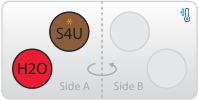
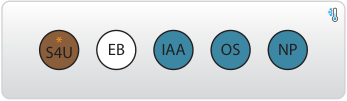
Figure 2. Location of kit components for the cell viability titration module, Cat. No. 059.24.
Cell Viability Titration Module
Tube Label
Volume Provided
Storage
Cat. No. 059.24 Kit Component
for 24 Preps
4-Thiouridine (100 mM)
S4U
900 µl
-20 °C / protect from light!
Molecular Biology Grade Water
H2O
1,500 µl
-20 °C
ATTENTION: S4U is light sensitive and can crosslink. Keep the cells and all the S4U-containing samples in the dark whenever possible (e.g., switch off the light in the hood, avoid opening and closing of the incubator during labeling time, shield samples from light during incubation times). Store S4U at -20 °C and avoid freeze-thaw cycles.
2.1 SLAMseq Explorer Kit - Cell Viability Titration Module
SLAMseq Explorer Kit - Cell Viability Titration Module,24份预制液 (-20 °C)
S4U H2O Side A Side B
图 2. 用于细胞活力滴定模块的试剂盒组件位置,Cat. No. 059.24。
细胞活力滴定模块
管标签
提供体积
储存
Cat. No. 059.24 试剂盒组件
用于 24 个制备
4-Thiouridine (100 mM)
S4U
900 µl
-20 °C / 避光!
Molecular Biology Grade Water
H2O
1,500 µl
-20 °C
注意:S4U 对光敏感且可能发生交联。尽可能在黑暗中保存细胞和所有含有 S4U 的样品(例如,关闭通风橱内的灯,避免在标记过程中频繁开关培养箱,在孵育期间遮挡样品免受光照)。将 S4U 储存在 -20 °C 并避免冷冻-解冻循环。
2.2 SLAMseq Explorer Kit - S4U Incorporation Module
ATTENTION: S4U is light sensitive and can crosslink. Keep the cells and all the S4U-containing samples in the dark whenever possible (e.g., switch off the light in the hood, avoid opening and closing of the incubator during labeling time, shield samples from light during incubation times). Store S4U at -20 °C and avoid freeze-thaw cycles.
ATTENTION: S4U is light sensitive and can crosslink. Keep the cells and all the S4U-containing samples in the dark whenever possible (e.g., switch off the light in the hood, avoid opening and closing of the incubator during labeling time, shield samples from light during incubation times). Store S4U at -20 °C and avoid freeze-thaw cycles.
ATTENTION: S4U is light sensitive and can crosslink. Keep the cells and all the S4U-containing samples in the dark whenever possible (e.g., switch off the light in the hood, avoid opening and closing of the incubator during labeling time, shield samples from light during incubation times). Store S4U at -20 °C and avoid freeze-thaw cycles.
注意:S4U 对光敏感且可能发生交联。在可能的情况下,请将细胞和所有含有 S4U 的样品保持避光(例如,关闭通风橱内的灯,避免在标记过程中打开和关闭培养箱,在孵育期间遮挡样品免受光照)。将 S4U 储存在 -20 °C 并避免冻融循环。
3. Detailed Protocol
3. 详细方案
3.1 The SLAMseq Explorer Kit
The Explorer Kit modules are required for optimizing S4U labeling conditions for SLAMseq experiments with cultured cells. Examples are given for experiments in 24-well plate format (see also p.5).
The kit consists of two modules that can be ordered and used individually.
To achieve optimal results in SLAMseq experiments, S4U uptake rates should be maximized without compromising cell viability. S4U cytotoxicity and uptake rates vary between cell types and culture conditions. Therefore, titration of S4U concentrations for metabolic labeling should be performed to determine optimal experimental conditions.
The S4U concentration cytotoxicity is best measured over a time scale that exceeds the labeling duration by a factor of at least 2. For example, use a 12-hour duration when planning 6-hour kinetics experiments.
Cell viability should be evaluated for a titration series of S4U concentrations to generate an inhibition vs S4U concentration curve. Typically, the trace can be fit by a sigmoidal curve to determine the half maximal inhibitory concentration, IC50,ti. The experimental working concentration is defined as IC10,ti. The IC10,ti level corresponds to the S4U concentration that inhibits 10 % of cells in the time window (ti), which is twice the duration of the intended kinetics experiments (Appendix A, p.28).
The provided reagents enable preparation of 10 ml of cell culture medium for each S4U dilution. The table below outlines the number of replicates (wells) per S4U dilution that can be included using the volume of reagents provided in the Cell Viability Titration Module.
Culture Volume per Well
Maximum No. Wells per Dilution
No. Replicates per Dilution (6 hr)*
No. Replicates per Dilution (12 hr)*
0.2 ml
50
25
12
0.5 ml
20
10
5
1 ml
10
5
2
2 ml
5
2
1
3 ml
3
1
0
*Accounting for 2 media exchanges for 6 hour labeling and 3 media exchanges for 12 hour labeling (see Appendix B, p.30).
50 ml vials Cell viability assay reagents and equipment
RT = Room Temperature
准备工作
SLAM-
测序试剂盒内容
用户提供
S4U
– 在室温下解冻 RT, 保持避光*
细胞培养基
H2O
– 在室温下解冻
50 ml 瓶装试剂 细胞活力测定试剂和设备
RT = 室温
Measuring S4U Concentration Cytotoxicity
Cells are incubated with a dilution series of 4-Thiouridine (S4U)-containing media in order to determine the optimal concentration for kinetics experiments. Cells should be seeded in culture plates prior to the addition of S4U-containing media. Timing and seeding rates should be adapted for the specified cell type so that optimal confluence is achieved at the end of the intended labeling duration. Cell viability should be measured using an appropriate assay such as the CellTiter-Glo® Luminescent Cell Viability Assay (Promega).
ATTENTION: Important notes for Cell Viability Titration Assays!
Exchange S4U-containing media every 3 hours. S4U incorporation rates may decrease over time. Regularly supplying fresh S4U-containing media significantly enhances S4U incorporation rates and allows for a more accurate determination of toxicity measures (see Appendix B, p.30).
Protect cell cultures and S4U-containing media from (white) light at all times! S4U is highly light sensitive and can crosslink. Work under red light and wrap samples with tin foil.
Thaw the tube of 4-Thiouridine (S4U). REMARK: Protect the solution from light at all times.
Prepare 12 tubes wrapped with tin foil. Add 10 ml of cell culture medium to each tube. Label tubes from 1 to 12.
Add 800 µl of the S4U solution to tube 1 and an additional 9.2 ml cell culture medium, resulting in a total volume of 20 ml. Mix well. ATTENTION: Keep the tube wrapped in tin foil to protect it from exposure to white light.
Transfer 10 ml of the S4U-containing media from tube 1 into tube 2. Mix well. Tube 2 will now contain 20 ml of a 1:2 dilution of the S4U concentration in tube 1. Transfer 10 ml of S4U-containing media from tube 2 into tube 3. Mix well. Tube 3 will now contain 20 ml of a 1:2 dilution from tube 2 and a 1:4 dilution compared to tube 1. Continue with this 1:2 dilution series as described above until you reach tube number 11.
Tube 12 will contain no S4U and will be used for the control cells. Add 800 µl of Molecular Biology Grade Water (H2O) and an additional 9.2 ml of culture media to tube 12, for a total volume of 20 ml.
Pre-warm the S4U-containing media to the desired cell incubation temperature. Remove media from the cells and replace it with the pre-warmed S4U-containing media.
Store the 12 tubes at 4 °C between media exchanges. For each media exchange, pre-warm a 2.1 ml aliquot of each S4U dilution in a fresh tube.
Exchange the S4U-containing media every 3 hours. The total time should equal twice the labeling duration for intended kinetics experiments, e.g., 12 hours for 6-hour experiments.
Measure the cell viability for each S4U concentration using an appropriate cell viability assay (e.g., CellTiter-Glo® Cell Viability Assay (Promega)).
Plot the cell viability measure vs concentration to obtain an inhibition vs S4U concentration curve. Tubes 1 to 11 represent a serial 1:2 dilution series, with concentrations ranging from 4 mM to 3.9 µM S4U. Tube 12 is the reference control and contains no S4U. Use this curve to determine the half-maximal inhibitory concentration (IC50,ti) and experimental working concentration (IC10,ti). A typical result is shown in Appendix A, p.28.
Direct validation of S4U incorporation rate is recommended when setting up SLAMseq experiments with new cell types or when experimental conditions are altered (e.g., labeling duration). Global S4U uptake can be measured using a convenient HPLC analysis assay, which comprises four steps. First, cells are cultured in the presence of S4U at the optimal IC10,ti concentration (see Cell Viability Titration Module, p.11). Second, samples are taken at exponentially increasing intervals for a time period equal to twice the labeling duration, e.g., 12 hours for a 6-hour experiment. Third, the RNA is isolated under reducing conditions before being digested to single nucleosides. After precipitation, the samples can be stored at -20 °C. The fourth and final step is HPLC analysis to measure the percentage of incorporated S4U, using two standard curves.
1.5 ml reaction tubes SpeedVac HPLC columns and equipment
RT = Room Temperature. Caution should be taken when using TRIzol®. Please consult material safety data sheets (MSDS) and use recommended safety procedures for handling and waste disposal.
Cells are incubated with 4-Thiouridine (S4U)-containing media. S4U will be incorporated in any newly synthesized RNA transcript instead of uridine. We recommend directly verifying the optimal IC10,ti concentration for the chosen cell type and intended labeling duration, before evaluating incorporation rates (see SLAMseq Explorer Kit - Cell Viability Titration Module, p.11). Reference IC10,ti concentrations are also provided as a guideline for selected cell types (Appendix E, p.34).
ATTENTION: Important notes for S4U Incorporation Assays!
Exchange S4U-containing media every 3 hours. S4U incorporation rates may decrease over time. Regularly supplying fresh S4U-containing media significantly enhances S4U incorporation rates (see Appendix B, p.30).
Protect cell cultures and S4U-containing media from (white) light at all times! S4U is highly light sensitive and can crosslink. Work in the dark or under red light, and wrap samples with tin foil.
Seed cells before the labeling experiment to reach maximal confluence or density at the end of the experiment. Seeding rates depend on the respective doubling time.
Prepare media containing S4U at the desired IC10,ti concentration (typically 50 - 500 µM). REMARK: The concentration depends on the cell type and should be determined beforehand (or see Appendix E, p.34).
Remove media from the cells and replace with S4U-containing media.
Harvest the cells for RNA sampling at time points of interest. Remove the S4U-containing media and lyse the cells directly in TRIzol®. Safe stopping point. Samples can be stored at -80 °C at this point.
培养细胞的 S4U 标记
Cells are incubated with 4-Thiouridine (S4U)-containing media. S4U will be incorporated in any newly synthesized RNA transcript instead of uridine. We recommend directly verifying the optimal IC10,ti concentration for the chosen cell type and intended labeling duration, before evaluating incorporation rates (see SLAMseq Explorer Kit - Cell Viability Titration Module, p.11). Reference IC10,ti concentrations are also provided as a guideline for selected cell types (Appendix E, p.34).
ATTENTION: Important notes for S4U Incorporation Assays!
Exchange S4U-containing media every 3 hours. S4U incorporation rates may decrease over time. Regularly supplying fresh S4U-containing media significantly enhances S4U incorporation rates (see Appendix B, p.30).
Protect cell cultures and S4U-containing media from (white) light at all times! S4U is highly light sensitive and can crosslink. Work in the dark or under red light, and wrap samples with tin foil.
Seed cells before the labeling experiment to reach maximal confluence or density at the end of the experiment. Seeding rates depend on the respective doubling time.
Prepare media containing S4U at the desired IC10,ti concentration (typically 50 - 500 µM). REMARK: The concentration depends on the cell type and should be determined beforehand (or see Appendix E, p.34).
Remove media from the cells and replace with S4U-containing media.
Harvest the cells for RNA sampling at time points of interest. Remove the S4U-containing media and lyse the cells directly in TRIzol®. Safe stopping point. Samples can be stored at -80 °C at this point.
RNA Isolation - Avoid exposure to light!
Here, a general TRIzol® protocol is described for RNA isolation following S4U labeling. The Reducing Agent (RA) is important for maintaining the S4U treated samples under constant reducing conditions. Other RNA extraction protocols may be used instead. However, RA must be added to isolation, wash, and elution buffers (see below).
ATTENTION: Important notes for RNA Isolation!
It is extremely important to perform the entire RNA isolation in the dark, or protected from (white) light exposure (e.g., by keeping the samples covered up, wrapping all tubes with tin foil, or working under red light).
If other RNA extraction methods are used, Reducing Agent (RA) must be added at 1/1,000th of the aqueous volume in isolation and wash buffers, and at 1/100th of the volume in elution or storage buffers.
If the volume of Reducing Agent (RA) to add is <1 µl, make a 1:10 dilution of RA with H2O.
REMARK: When preparing mastermixes always include a 10 % surplus per reaction.
If samples were previously frozen, thaw the lysate and incubate for 5 minutes at room temperature.
Add 200 µl chloroform:isoamyl alcohol mix (24:1) per 1 ml of TRIzol® lysate.
Shake the tube vigorously for 15 seconds.
Incubate for 3 minutes at room temperature.
Centrifuge at 16,000 x g for 15 minutes at 4 °C.
Transfer the colorless upper aqueous phase to a new tube. Measure the volume of the aqueous phase using a pipette. ATTENTION: Careful pipetting is required to avoid transfer of the lower organic phase.
Add to the aqueous phase 1 µl of Carrier Substance (CS), 1/1,000th volumes of Reducing Agent (RA), and 1 volume of 2-propanol. Vortex well.
Incubate for 10 minutes at room temperature. Spin down at 16,000 x g for 20 minutes at 4 °C. Remove and discard the supernatant.
Wash the pellet with 500 µl 75 % EtOH and 0.5 µl of Reducing Agent ( RA ). Vortex well. Spin down at 7,500 x g for 5 minutes at room temperature.
Remove supernatant. Let the pellet dry for 5 - 10 minutes and resuspend it in 20 µl of Elution Buffer ( EB ). Incubate for 10 minutes at 55 °C.
Measure the concentration by NanoDrop. Proceed with Digestion to Single Nucleosides to prepare the samples for HPLC analysis. Safe stopping point. At this point RNA can also be stored at -80 °C.
RNA Isolation - Avoid exposure to light!
Here, a general TRIzol® protocol is described for RNA isolation following S4U labeling. The Reducing Agent (RA) is important for maintaining the S4U treated samples under constant reducing conditions. Other RNA extraction protocols may be used instead. However, RA must be added to isolation, wash, and elution buffers (see below).
ATTENTION: Important notes for RNA Isolation!
It is extremely important to perform the entire RNA isolation in the dark, or protected from (white) light exposure (e.g., by keeping the samples covered up, wrapping all tubes with tin foil, or working under red light).
If other RNA extraction methods are used, Reducing Agent (RA) must be added at 1/1,000th of the aqueous volume in isolation and wash buffers, and at 1/100th of the volume in elution or storage buffers.
If the volume of Reducing Agent (RA) to add is <1 µl, make a 1:10 dilution of RA with H2O.
REMARK: When preparing mastermixes always include a 10 % surplus per reaction.
If samples were previously frozen, thaw the lysate and incubate for 5 minutes at room temperature.
Add 200 µl chloroform:isoamyl alcohol mix (24:1) per 1 ml of TRIzol® lysate.
Shake the tube vigorously for 15 seconds.
Incubate for 3 minutes at room temperature.
Centrifuge at 16,000 x g for 15 minutes at 4 °C.
Transfer the colorless upper aqueous phase to a new tube. Measure the volume of the aqueous phase using a pipette. ATTENTION: Careful pipetting is required to avoid transfer of the lower organic phase.
Add to the aqueous phase 1 µl of Carrier Substance (CS), 1/1,000th volumes of Reducing Agent (RA), and 1 volume of 2-propanol. Vortex well.
在室温下孵育 10 分钟。在 4 °C 下以 16,000 x g 离心 20 分钟。去除并丢弃上清液。
用 500 µl 75 % EtOH 和 0.5 µl 的还原剂 ( RA ) 洗涤沉淀。涡旋振管。在室温下以 7,500 x g 离心 5 分钟。
By digesting the RNA to single nucleosides and subsequent HPLC analysis, the efficiency of global S4U incorporation can be quantified. This protocol requires μg-scale amounts of total RNA input. DNase I treatment is not required prior to RNA digestion, but can be performed in addition if desired.
REMARK: If HPLC analysis is not feasible, the RNA can be further processed using iodoacetamide for alkylation using the SLAMseq Kinetics Kit Modules (Cat. No. 061, 062). The total RNA after alkylation can then be used as input for NGS library preparation, e.g. with QuantSeq 3’ mRNA-Seq V2 Library Prep Kits (Cat. No. 191 - 196). Previous versions of QuantSeq 3’ mRNASeq are also compatible. The S4U incorporation can be evaluated by measuring the frequency of total T > C conversions in comparison to the reference, e.g., by running the sample as a spike-in for a regular single-read NGS run (SR100 read format is recommended).
Prepare a mastermix with 18 µl of Digestion Buffer ( DB ) and 2 µl of Digestion Enzyme Mix ( DE ) per reaction. REMARK: When preparing mastermixes always include a 10 % surplus per reaction.
Add 20 µl of the DB / DE mastermix to a μg-scale amount of isolated total RNA. Bring up the total volume to 130 µl with Molecular Biology Grade Water ( H2O ).
Incubate overnight (≥16 hours) at 37 °C. Add 6 µl of Sodium Acetate ( NA ), 150 µl ice-cold 100 % EtOH, and 3 µl Reducing Agent ( RA ). Vortex. Incubate 10 minutes at -80 °C. REMARK : Alternatively, incubate on dry ice for 10 minutes, or at -20 °C for 1 hour.
Spin down at 12,500 x g for 5 minutes at 4 °C.
Transfer the supernatant to a new 1.5 ml tube and discard the pellet.
Add 3 µl Reducing Agent ( RA ) and 270 µl ice-cold 100 % EtOH to the supernatant. Vortex. Incubate 10 minutes at -80 °C. REMARK : Alternatively, incubate on dry ice for 10 minutes, or at -20 °C for 1 hour.
Spin down at 12,500 x g for 5 minutes at 4 °C.
Transfer the supernatant to a new 1.5 ml tube.
Evaporate the supernatant to complete dryness using a vacuum concentrator, e.g., SpeedVac (V-AL setting).
Resuspend the sample in 50 µl of Molecular Biology Grade Water ( H2O ), and store at -20 °C until the sample is analyzed by HPLC. Safe stopping point.
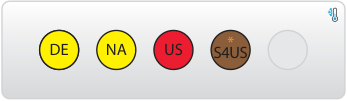
Digested RNA samples are compared against dilutions of the Uridine Standard ( US ) and S4U Standard ( S4US ) using HPLC analysis.
HPLC analysis is carried out using a Supelco Discovery C18 reverse phase (bonded phase 5 µl silica particles) or equivalent column. Mobile phase solutions A and B contain Acetonitrile and Triethylamine-acetic acid buffer (TEAA), and Acetonitrile and Molecular Biology Grade Water ( H2O ), respectively (user-supplied).
Take 25 µl of the digested RNA sample and add 75 µl Molecular Biology Grade Water ( H2O ).
Thaw the Uridine Standard ( US ) and S4U Standard ( S4US ) tubes. ATTENTION: Do not use the S4U tube!
Prepare 6 standard solutions that contain exponentially increasing concentrations of US and S4US.
US Volume
S4US Volume
H2O Volume
US Final Concentration
S4US Final Concentration
Std 1: 40 µl
50 µl
10 µl
320 µM
4 µM
Std 2: 20 µl
25 µl
55 µl
160 µM
2 µM
Std 3: 10 µl
12.50 µl
77.50 µl
80 µM
1 µM
Std 4: 5 µl
6.25 µl
88.75 µl
40 µM
0.5 µM
Std 5: 2.50 µl
3.12 µl
94.38 µl
20 µM
0.25 µM
Std 6: 1.25 µl
1.56 µl
97.19 µl
10 µM
0.125 µM
Prepare mobile phase solution A with a final concentration of 3 % Acetonitrile, and 0.1 M TEAA, pH 7.0 in H2O.
Prepare mobile phase solution B with a final concentration of 90 % Acetonitrile in H2O. When using Supelco Discovery C18 reverse phase columns with a size of 250 x 4.6 mm the isocratic gradient to use is: 0 % B for 15 minutes, 0 – 10 % B for 20 minutes, and 10 – 100 % B for 30 minutes. A 5 minute 100 % B wash between the runs is recommended. REMARK: These running conditions refer to the method described by Spitzer et al., Methods Enzymol. 2014 ; 539: 113–161 , and should be modified with respect to the available column size and type.
Prepare the two calibration curves by injecting the standards 1 to 6. Record the chromatogram at 260 nm, and if possible, at 330 nm. The order of retention time is Uridine Standard ( US ) followed by S4U Standard ( S4US ).
Inject the digested RNA samples sequentially and measure the absorbance at Uridine Standard ( US ) and S4U Standard ( S4US ) retention times at 260 nm and 330 nm. The order of retention times for all ribonucleosides present is: Cytosine, Uridine, Guanine, 4-Thiouridine (S4U), and Adenine. Use the standard curves to define the respective concentrations.
To determine the incorporation rate, plot the S4U percentage versus concentration (see Appendix B, p.30).
制备流动相溶液 B,其最终浓度为 90 % Acetonitrile 在 H2O 中。当使用尺寸为 250 x 4.6 mm 的 Supelco Discovery C18 反相色谱柱时,应使用的等度梯度如下:0 % B 运行 15 分钟,0 – 10 % B 运行 20 分钟,以及 10 – 100 % B 运行 30 分钟。建议在每次运行之间进行 5 分钟的 100 % B 清洗。备注:这些运行条件参考了 Spitzer et al., Methods Enzymol. 2014 ; 539: 113–161 所描述的方法,应根据可用的色谱柱尺寸和类型进行修改。
通过注入标准品 1 至 6 来制备两个校准曲线。在 260 nm 记录色谱图,如果可能,也记录 330 nm 的数据。保留时间的顺序是 Uridine Standard (US) 随后是 S4U Standard (S4US)。
按顺序注入消化后的 RNA 样本,并在 260 nm 和 330 nm 的 Uridine Standard (US) 和 S4U Standard (S4US) 保留时间处测量吸光度。所有存在的核糖核苷酸的保留时间顺序为:Cytosine、Uridine、Guanine、4-Thiouridine (S4U) 和 Adenine。使用标准曲线来确定各自的浓度。
要确定掺入率,请绘制 S4U 百分比与浓度的关系图(参见附录 B,第 30 页)。
3.2 The SLAMseq Kinetics Kit
The SLAMseq Kinetics Kit modules are used to measure RNA synthesis and degradation rates by distinguishing nascent from existing RNA as a function of time. The Anabolic Kinetics Module (Cat. No. 061) measures RNA synthesis while the Catabolic Kinetics Module (Cat. No. 062) measures RNA degradation. Each module contains the compounds needed for labeling, stabilizing labeled RNA during isolation, and S4U alkylation. The workflow for S4U RNA labeling differs between Anabolic Kinetics (see 3.2.1) and Catabolic Kinetics (see 3.2.2) experimental designs and is explained in the respective sections.
The module is optimized for short (pulse) S4U labeling durations. This strategy labels nascent RNA for measuring RNA synthesis rates. Sampling occurs in logarithmic intervals (for example, $2^n \times$ 15 minutes). An example of an Anabolic Kinetics labeling experiment result is shown in Appendix C, p.32.
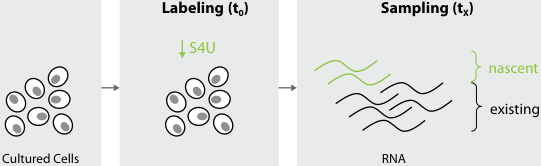
Figure 6. Schematic workflow of SLAMseq for anabolic RNA kinetics measurements. At t0, modified nucleotides (S4U) are added, which label newly synthesized RNA (nascent, in green). Existing RNA (in black) is unlabeled. At measurement of transcript synthesis rates. x, RNA synthesis is stopped by cell lysis and RNA isolation. Sampling at different intervals, tx, allows for measuring transcript synthesis rates.
RT = Room Temperature. ** Caution should be taken when using TRIzol ® . Please consult material safety data sheets (MSDS) and use recommended safety procedures for handing and waste disposal.
Cells are incubated with 4-Thiouridine ( S4U )-containing media. S4U will be incorporated into newly synthesized RNA transcripts instead of uridine.
ATTENTION: Important notes for Kinetics Assays!
Exchange S4U-containing media every 3 hours. S4U incorporation rates may decrease over time. Regularly supplying fresh S4U-containing media significantly enhances S4U incorporation rates for longer duration labeling assays (see Appendix B, p.30).
Protect cell cultures and S4U-containing media from (white) light at all times! S4U is highly light sensitive and can crosslink. Work in the dark or under red light, and wrap samples with tin foil.
Seed cells before the labeling experiment to reach maximal confluence or density at the end of the experiment. Seeding rates depend on the respective doubling time.
Prepare media containing S4U at the desired IC10,ti concentration (typically 50 - 500 µM). REMARK: The concentration depends on the cell type and should be determined beforehand using the SLAMseq Explorer Kit (or see Appendix E, p.34).
Remove media from the cells and replace it with S4U-containing media at t0. ATTENTION: S4U is light sensitive. Wrap culture plates in tin foil to prevent exposure to light during incubation.
Take off media at desired time points, tx, and lyse the cells directly in TRIzol®. Safe stopping point. Samples can be stored at -80° C at this point.
Here, a general TRIzol® protocol is described for RNA isolation following S4U labeling. The Reducing Agent ( RA ) is important for maintaining the S4U treated samples under constant reducing conditions. Other RNA extraction protocols may be used instead. However, RA must be added to isolation, wash and elution buffers (see below).
ATTENTION: Important notes for RNA Isolation!
It is extremely important to perform the entire RNA isolation in the dark, or protected from (white) light exposure (e.g., by keeping the samples covered up, wrapping all tubes with tin foil, or working under red light).
If other RNA extraction methods are used, Reducing Agent ( RA ) must be added at 1/1,000th of the aqueous volume in isolation and wash buffers, and at 1/100th of the volume in elution or storage buffers.
If the volume of Reducing Agent ( RA ) to add is <1 µl, make a 1:10 dilution of RA with H2O.
REMARK: When preparing mastermixes always include a 10 % surplus per reaction.
|If samples were previously frozen, thaw the lysate and incubate for 5 minutes at room temperature.|
|Add 200 µl chloroform:isoamyl alcohol mix (24:1) per 1 ml of TRIzol® lysate.|
|Shake the tube vigorously for 15 seconds.|
|Incubate for 3 minutes at room temperature.|
|Centrifuge at 16,000 x g for 15 minutes at 4 °C.|
|Transfer the colorless upper aqueous phase to a new tube. Measure the volume of the aqueous phase using a pipette.ATTENTION:Careful pipetting is required to avoid transfer of the lower organic phase.|
|Add to the aqueous phase 1 µl of Carrier Substance (CS), 1/1,000thvolumes of Reducing Agent (RA ), and 1 volume of 2-propanol. Vortex well.|
|Incubate for 10 minutes at room temperature.|
|Centrifuge at 16,000 x g for 20 minutes at 4 °C.|
|Remove and discard the supernatant.|
|Wash the pellet with 500 µl 75 % EtOH and 0.5 µl of Reducing Agent (RA ). Vortex well.|
|Centrifuge at 7,500 x g for 5 minutes at 4 °C.|
|Remove supernatant. Let the pellet dry for 5 - 10 minutes, and resuspend it in 16 µl of Elution Buffer (EB).|
|Incubate for 10 minutes at 55 °C.|
|Measure the concentration by NanoDrop. Safe stopping point. At this point RNA can be stored at -80 °C.ATTENTION:As S4U can become unstable over time it is best to proceed to alkylation with iodoacetamide as soon as possible.|
|Proceed with Iodoacetamide treatment of the RNA to alkylate S4U nucleotides before library preparation and sequencing.|
After total RNA is isolated, the 4-thiol groups present on S4U-labeled transcripts are alkylated with Iodoacteamide ( IAA ). When using the resulting modified total RNA for downstream NGS library preparation, such as QuantSeq 3‘ mRNA-Seq V2 Library preps (Cat. No. 191 - 196), the reverse transcriptase incorporates a Guanine (G) instead of an Adenine (A) wherever an alkylated S4U nucleotide is encountered. Previous versions of QuantSeq 3' mRNA-Seq kits are also compatible.
ATTENTION: The initial steps of the Iodoacetamide treatment with the isolated total RNA must be performed in the dark, or protected from (white) light exposure (e.g., by keeping the samples covered up, wrapping all tubes with tin foil, or working under red light).
Dissolve 1 tube of Iodoacetamide (IAA) in 500 µl of 100 % EtOH for a 100 mM final concentration. ATTENTION: Use only freshly prepared Iodoacetamide. Test all samples in parallel! Dissolved Iodoacetamide should not be reused.
Prepare a mastermix containing 5 µl of the freshly prepared 100 mM Iodoacetamide (IAA), 25 µl of Organic Solvent (OS), and 5 µl of Sodium Phosphate (NP) per sample. ATTENTION: NP can form salt aggregates when added to OS. This does not affect the downstream reaction, but we recommend preparing a slightly larger mastermix and transfer just the supernatant to the reaction. REMARK: When preparing mastermixes always include a 10 % surplus per reaction.
Mix 15 µl of RNA (up to 5 µg of RNA from step20) with 35 µl of the IAA / OS / NP mastermix. If required, add Molecular Biology Grade Water (H2O) to a total reaction volume of 50 µl.
Incubate the reaction for 15 minutes at 50 °C.
Stop the reaction by adding 1 µl of Stopping Reagent (SR). Mix well. REMARK: After this step exposure to light is possible.
Add 1 µl of Carrier Substance (CS), 5 µl of Sodium Acetate (NA), and 125 µl of 100 % EtOH. Vortex and precipitate for 30 minutes at -80 °C.
Centrifuge at 16,000 x g for 30 minutes at 4 °C.
Remove the supernatant and wash the pellet with 1 ml 75 % EtOH. Vortex.
Centrifuge at 16,000 x g for 10 minutes at 4 °C.
Remove the supernatant and let the pellet dry for 5 - 10 minutes.
Resuspend in an appropriate volume (5 - 10 µl) of Molecular Biology Grade Water (H2O).
Proceed with RNA quality control and library preparation. For SLAMseq RNA sequencing we recommend using the QuantSeq 3’ mRNA-Seq V2 Library Prep Kits (Cat. No. 191 -196). Safe stopping point. Samples can be stored at -80° C at this point.
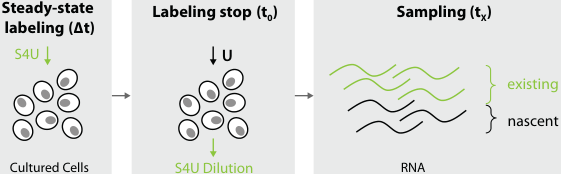
The Catabolic Kinetics Module uses a long S4U labeling step to allow RNA metabolism to reach an approximate steady-state level. The exchange of S4U for unlabeled uridine in the cell culture media stops RNA labeling. Sampling occurs over a time course after unlabeled uridine is added. In this way, RNAs synthesized during the S4U labeling phase represent existing transcripts. Nascent RNAs synthesized after S4U is exchanged for uridine are unlabeled. Measuring the decrease in S4U-labeled existing RNA reveals RNA degradation rates. An example of a Catabolic Kinetics labeling experiment result is shown in Appendix D, p.33.
Figure 7. Schematic workflow of SLAMseq for catabolic RNA kinetics measurements. Over Δt, which may extend for up to 24 hours, cells are cultured in S4U-containing media to establish approximate steady-state labeling of the RNA. At t0, the culture media is replaced with media containing unlabeled uridine (U), which displaces S4U in the cells and stops the labeling of newly synthesized RNA. Subsequently, only existing RNA is labeled (green) while all nascent RNA made after the addition of unlabeled (in black). At tis isolated. Sampling at different intervals, tx, allows for measurement of transcript degradation rates. x, cells are sampled and lysed and RNA
RT = Room Temperature. Caution should be taken when using TRIzol®. Please consult material safety data sheets (MSDS) and use recommended safety procedures for handling and waste disposal.
Cells are incubated with 4-Thiouridine ( S4U )-containing media. S4U will be incorporated into newly synthesized RNA transcripts instead of uridine.
ATTENTION: Important notes for Kinetics Assays!
Exchange S4U-containing media every 3 hours. S4U incorporation rates may decrease over time. Regularly supplying fresh S4U-containing media significantly enhances S4U incorporation rates for longer duration labeling assays (see Appendix B, p.30).
Protect cell cultures and S4U-containing media from (white) light at all times! S4U is highly light sensitive and can crosslink. Work in the dark or under red light, and wrap samples with tin foil.
Seed cells before the labeling experiment to reach maximal confluence or density at the end of the experiment. Seeding rates depend on the respective doubling time.
Prepare media containing S4U at the desired IC10,ti concentration (typically 50 - 500 µM). REMARK: The concentration depends on the cell type and should be determined beforehand (or see Appendix E, p.34).
Remove media from the cells and replace it with S4U-containing media at t0.
Incubate cells for up to 24 hours. Exchange media with new S4U-containing media every 3 hours. ATTENTION: S4U is light sensitive. Wrap culture plates in tin foil to prevent exposure to light.
By exchanging the 4-Thiouridine ( S4U ) containing media with media containing 100x excess of unlabeled Uridine ( U ), the labeling of nascent RNA will be stopped. Newly synthesized transcripts will not contain S4U, while existing transcripts will be labeled with S4U.
ATTENTION: Protect the cells from (white) light during Labeling Stop to prevent cross-linking of S4U already incorporated into the RNA. Wrap culture plates in tin foil to prevent exposure to light, and/or work under red light.
Prepare media containing 100x excess of Uridine ( U ) relative to the original S4U concentration in the media. EXAMPLE: If 100 µM S4U was used during the labeling, the labeling stop media should contain a final concentration of 10 mM U. Uridine stock concentration is 500 mM. Therefore, for 10 mM, add 480 µl of 500 mM U to a total volume of 24 ml cell culture medium.
Remove the S4U-containing media from the cells at t0.
Wash the cells twice with 1x PBS or cell-compatible cell wash buffer (provided by user).
Add the media with excess Uridine ( U ) to the cells.
Take off media at the time points of interest, tx, and lyse the cells directly in TRIzol®. Safe stopping point. Samples can be stored at -80 °C at this point.
Here, a general TRIzol® protocol is described for RNA isolation following S4U labeling. The Reducing Agent ( RA ) is important for maintaining the S4U treated samples under constant reducing conditions. Other RNA extraction protocols may be used instead. However, RA must be added to isolation, wash, and elution buffers (see below).
ATTENTION: Important notes for RNA Isolation!
It is extremely important to carry out the RNA extraction in the dark or protected from (white) light exposure (e.g., by keeping the samples covered up, wrapping all tubes with tin foil, or working under red light).
If other RNA extraction methods are used, Reducing Agent ( RA ) must be added at 1/1,000th of the aqueous volume in isolation and wash buffers, and at 1/100th of the volume in elution or storage buffers.
If the volume of Reducing Agent ( RA ) to add is <1 µl, make a 1:10 dilution of RA with H2O.
REMARK: When preparing mastermixes always include a 10 % surplus per reaction.
If samples were previously frozen, thaw the lysate and incubate for 5 minutes at room temperature.
Add 200 µl chloroform:isoamyl alcohol mix (24:1) per 1 ml of TRIzol® lysate.
Shake the tube vigorously for 15 seconds.
Incubate for 3 minutes at room temperature.
Centrifuge at 16,000 x g for 15 minutes at 4 °C.
Transfer the colorless upper aqueous phase to a new tube. Measure the volume of the aqueous phase using a pipette. ATTENTION: Careful pipetting is required to avoid transfer of the lower organic phase.
Add to the aqueous phase 1 µl of Carrier Substance ( CS ), 1/1,000th volumes of Reducing Agent ( RA ), and 1 volume of 2-propanol. Vortex well.
Incubate for 10 minutes at room temperature.
Centrifuge 16,000 x g for 20 minutes at 4 °C.
Remove and discard the supernatant.
Wash the pellet with 500 µl 75 % EtOH and 0.5 µl of Reducing Agent (RA). Vortex well.
Centrifuge at 7,500 x g for 5 minutes at 4 °C.
Remove supernatant. Let the pellet dry for 5 - 10 minutes, and resuspend it in 16 µl of Elution Buffer (EB).
Incubate for 10 minutes at 55 °C.
Measure the concentration by NanoDrop. Safe stopping point. At this point RNA can be stored at -80 °C.ATTENTION: As S4U can become unstable over time, it is best to proceed to alkylation with iodoacetamide as soon as possible.
Proceed with Iodoacetamide treatment of the RNA to alkylate S4U nucleotides before library preparation and sequencing.
RNA 分离 - 避免暴露在光下!
在此,描述了一个针对 S4U 标记后进行 RNA 分离的通用 TRIzol® 方案。还原剂 ( RA ) 对于在恒定还原条件下保持经过 S4U 处理的样品至关重要。也可以使用其他 RNA 提取方案。然而,必须将 RA 添加到分离、洗涤和洗脱缓冲液中(见下文)。
在室温下孵育 10 分钟。
在 4 °C 下以 16,000 x g 的速度离心 20 分钟。
移除并丢弃上清液。
用 500 µl 的 75 % EtOH 和 0.5 µl 的Reducing Agent (RA) 洗涤沉淀。充分涡旋混合。
在 4 °C 下以 7,500 x g 的速度离心 5 分钟。
移除上清液。让沉淀干燥 5 - 10 分钟,然后将其重新悬浮在 16 µl 的Elution Buffer (EB) 中。
在 55 °C 下孵育 10 分钟。
使用NanoDrop测量浓度。安全停止点。此时RNA可以储存在 -80 °C 下。注意: 由于S4U会随时间变得不稳定,最好尽快进行iodoacetamide烷基化处理。
在文库制备和测序之前,对RNA进行Iodoacetamide处理以烷基化S4U核苷酸。
Iodoacetamide Treatment
After total RNA is isolated, the 4-thiol groups present on S4U-labeled transcripts are alkylated with Iodoacetamide ( IAA ). When using the resulting modified total RNA for downstream NGS library preparation, such as QuantSeq 3‘ mRNA-Seq V2 Library preps (Cat. No. 191 - 196), the reverse transcriptase incorporates a Guanine (G) instead of an Adenine (A) wherever an alkylated S4U nucleotide is encountered. Previous versions of QuantSeq 3' mRNA-Seq kits are also compatible.
ATTENTION: The initial steps of the Iodoacetamide treatment with the isolated total RNA must be performed in the dark, or protected from (white) light exposure (e.g., by keeping the samples covered up, wrapping all tubes with tin foil, or working under red light).
Dissolve 1 tube of Iodoacetamide ( IAA ) in 500 µl of 100 % EtOH for a 100 mM final concentration. ATTENTION: Use only freshly prepared Iodoacetamide. Test all samples in parallel! Dissolved Iodoacetamide should not be reused.
Prepare a mastermix containing 5 µl of the freshly prepared 100 mM Iodoacetamide ( IAA ), 25 µl of Organic Solvent ( OS ), and 5 µl of Sodium Phosphate ( NP ) per sample. ATTENTION: NP can form salt aggregates when added to OS. This does not affect the downstream reaction, but we recommend to prepare a slightly larger mastermix and transfer just the supernatant to the reaction. REMARK: When preparing mastermixes always include a 10 % surplus per reaction.
Mix 15 µl of RNA (up to 5 µg of RNA from step24 ) with 35 µl of the IAA / OS / NP mastermix. If required, add Molecular Biology Grade Water ( H2O ) to a total reaction volume of 50 µl.
Incubate the reaction for 15 minutes at 50 °C. Stop the reaction by adding 1 µl of Stopping Reagent ( SR ). Mix well. REMARK: After this step, exposure to light is possible. Add 1 µl of Carrier Substance ( CS ), 5 µl of Sodium Acetate ( NA ), and 125 µl of 100 % EtOH. Vortex and precipitate for 30 minutes at -80 °C.
Centrifuge at 16,000 x g for 30 minutes at 4 °C.
Remove the supernatant and wash the pellet with 1 ml 75 % EtOH. Vortex. Centrifuge at 16,000 x g for 10 minutes at 4 °C.
Remove the supernatant and let the pellet dry for 5 - 10 minutes.
Resuspend in an appropriate volume (5 - 10 µl) of Molecular Biology Grade Water ( H2O ). Proceed with RNA quality control and library preparation. For SLAMseq RNA sequencing, we recommend using the QuantSeq 3’ mRNA-Seq V2 Library Prep Kits (Cat. No. 191 - 196). Safe stopping point. Samples can be stored at -80° C at this point.
S4U uptake varies between cell types and culture conditions. At the start of an experimental series or when using new cell types, the S4U concentration should be titrated to determine optimal experimental conditions for metabolic labeling. The table below outlines the 1:2 dilution series recommended for Cell Viability Titration Assays using this module.
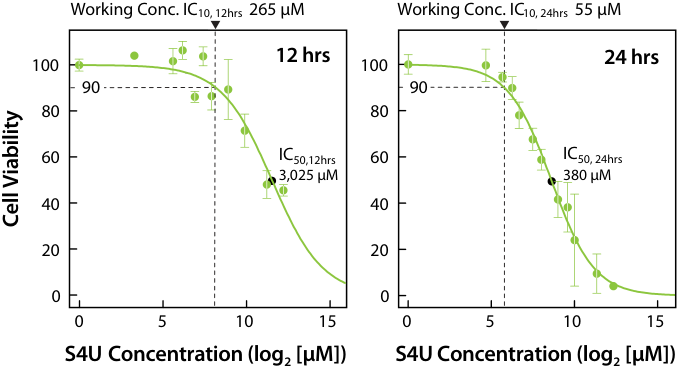
The S4U concentration cytotoxicity is measured over a time scale equal to twice the labeling duration, e.g., 12 hours for 6-hour experiments. The inhibition vs S4U concentration curve is determined by measuring cell viability over an S4U dilution series. Typically, the trace can be fit by a sigmoidal curve to determine the half-maximal inhibitory concentration, IC50,ti. The optimal experimental working concentration is defined as the IC10,ti : the S4U concentration that would inhibit a maximum of 10 % of cells in the given time window (ti).
Figure 8. Viability of mouse embryonic stem (mES) cells cultured in the presence of the indicated concentration of 4-Thiouridine (S4U) for 12 hours (left) or 24 hours (right). Viability is expressed relative to untreated cells (100 %). S4U-containing media was exchanged every 3 hours over the course of the labeling experiment. The optimal working concentrations, IC10,ti used in subsequent experiments (265 µM, and 55 µM) are indicated by triangles on top of each plot and dotted lines. Cell viability was measured with the CellTiter-Glo® Luminescent Cell Viability Assay (Promega).
4-Thiouridine (S4U) incorporation rates vary depending on the type of cell line and labeling duration. The S4U Incorporation Module allows for direct measurement of the rate of S4U uptake and incorporation into newly synthesized RNA. Cells are cultured in the presence of S4Ucontaining media at the pre-determined optimal IC10,ti concentration.
RNA is sampled at time points of exponentially increasing intervals, extending to twice the duration of the intended kinetics experiment (e.g., 0, 4, 8, 12, and 24-hour time points are taken for a 12-hour kinetics experiment). The S4U-containing media is removed at the time points of interest and cells are lysed directly in TRIzol®. Cell lysates can be stored at -80 °C prior to RNA isolation.
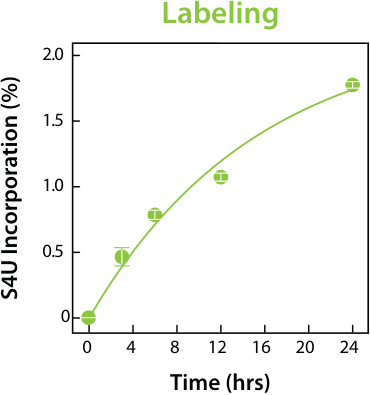
After isolation, the RNA is digested to single nucleosides, precipitated, and analyzed by using High Performance Liquid Chromatography (HPLC). The level of S4U incorporated is calculated as a percentage of total uridine for each time point sampled. Plot the incorporation percentage vs time to determine the incorporation rate kinetics.
Figure 9. Incorporation rate of S4U as a percentage of total uridine levels, as determined by HPLC. S4U incorporation in total RNA across all time points of a S4U-metabolic labeling experiment in cultured mouse embryonic stem (mES) cells. Values represent mean ± SD of three independent replicates. Maximum incorporation rates after 24 hours of labeling are shown.
REMARK: S4U incorporation rates for mRNA may be higher than estimated by HPLC analysis of single nucleoside-digested total RNA. This is because stable RNA polymerase I and III transcripts, such as rRNA and tRNA, are overrepresented in total RNA but depleted from RNA polymerase II-specific mRNA-Seq libraries.
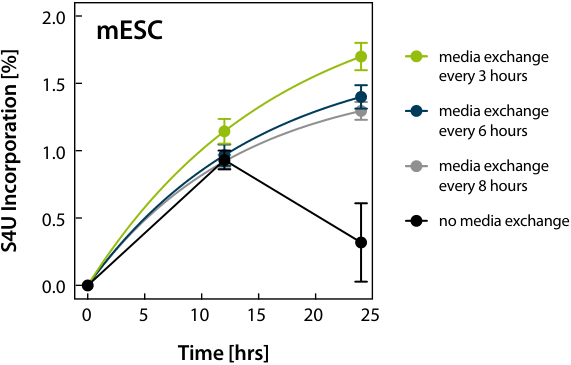
S4U incorporation rates may decrease over time, which can affect the level of T > C read counts that will be detected at later timepoints. Regularly supplying fresh S4U-containing media significantly enhances S4U incorporation rates, allows for a more accurate determination of toxicity measures for cell viability assays, and provides more accurate kinetics data for calculating RNA synthesis and degradation rates. Exchanging the S4U-containing media every 3 hours maintains optimal incorporation rates. Longer durations between media exchange may lead to reduced incorporation rates.
2.0 mESC media exchange every 3 hours 1.5 media exchange every 6 hours 1.0 media exchange every 8 hours 0.5 no media exchange 0.0 0 5 10 15 20 25 Time [hrs] S4U Incorporation [%]
Figure 10. Incorporation rate of S4U for mouse embryonic stem cells (mESC). Media exchange every 3, 6, or 8 hours was compared to no media exchange over a total duration of 24 hours. Cells without media exchange show reduced incorporation rates particularly after 12 - 14 hours. Media exchange every 3 hours produced the highest incorporation rate over time.
2.0 mESC media exchange every 3 hours 1.5 media exchange every 6 hours 1.0 media exchange every 8 hours 0.5 no media exchange 0.0 0 5 10 15 20 25 Time [hrs] S4U Incorporation [%]
If HPLC analysis is not feasible, the RNA can be further processed using Iodoacetamide for alkylation using the SLAMseq Kinetics Kit Modules (Cat. No. 061, 062). The total RNA after alkylation can then be used as input for NGS library preparation, i.e., with QuantSeq 3’ mRNA-Seq V2 Library Prep Kits (Cat. No. 191 - 196). Previous versions of QuantSeq 3’ mRNA-Seq are also compatible with SLAMseq. The S4U incorporation can be evaluated by measuring the frequency of total T > C conversions in comparison to the reference, e.g., by running the sample as a spike-in for a regular single-read NGS run (SR100 read format is recommended).
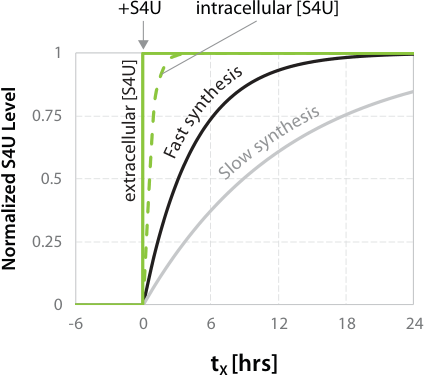
The SLAMseq Kinetics Kit - Anabolic Kinetics differentiates between nascent and existing RNA. At t0, modified nucleotides (S4U) are added to cell culture media, which results in labeling of newly synthesized RNA. Existing RNA remains unlabeled. At tx, the RNA synthesis is stopped by cell lysis and RNA isolation. Sampling at different intervals, tx, allows for measurement of transcript synthesis rates.
Total RNA isolated from SLAMseq anabolic kinetics experiments can be used for NGS library preparation after alkylation with Iodoacetamide. S4U levels in labeled transcripts are distinguished in the final sequencing reads by the presence of T > C nucleotide conversions. Counting the number of reads with T > C conversions over a time course reveals the RNA synthesis kinetics for individual transcripts (see Data Analysis, Appendix F, p.35).
Specific measurement of nascent RNA levels provides insights into transcriptome-wide RNA synthesis dynamics.
+S4U intracellular [S4U] 1 0.75 0.5 0.25 0 -6 0 6 12 18 24 tX [hrs] thesis s yn si s w e Slo th n sy t s a F extracellular [S4U] Normalized S4U Level
Figure 11. Anabolic kinetics labeling experiment time course. Culturing cells with S4U-containing media (extracellular [S4U], solid green line) changes the intracellular S4U concentration (dashed green line). Nascent RNA will be labelled starting from t0. Time course measurements determine RNA synthesis rates. Transcripts with fast (black solid line) and slow (gray solid line) synthesis rates can be distinguished by relative differences in the increase in S4U detection over time. S4U levels for individual transcripts are measured by counting sequencing reads with T > C conversions.
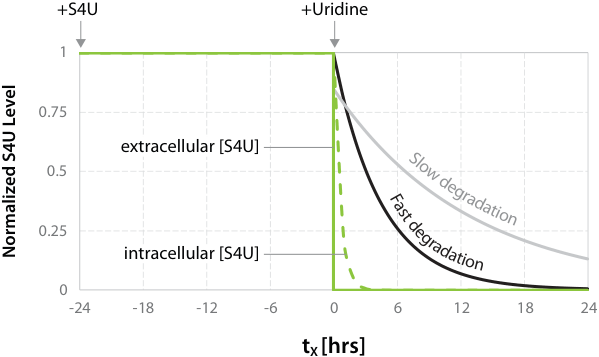
The Catabolic Kinetics Module uses a long initial S4U labeling duration to enable RNA metabolism to reach an approximate steady-state level. The exchange of S4U for unlabeled uridine in cell media stops the labeling at t0. Sampling is carried out over a time course (tx up to 24 hours) after the unlabeled uridine is added. In this way, existing RNA made during incubation with S4U is labeled, while nascent RNA synthesized after S4U is exchanged for uridine is unlabeled. The experiment monitors RNA degradation rates.
Total RNA isolated from SLAMseq catabolic kinetics experiments can be used for NGS library preparation after alkylation with iodoacetamide. S4U levels in labeled transcripts are distinguished in the final sequencing reads by the presence of T > C nucleotide conversions. Counting the number of reads with T > C conversions over a time course reveals the RNA degradation kinetics for individual transcripts (see Data Analysis, Appendix F, p.35).
+S4U +Uridine 1 0.75 extracellular [S4U] 0.5 0.25 intracellular [S4U] 0 -24 -18 -12 -6 0 6 12 18 24 tX [hrs] tion on a ati d rad eg ra w d g Slo de st F a Normalized S4U Level
Figure 12. Catabolic kinetics labeling experiment time course. Initial steady-state labeling of RNA is achieved by incubating cells in S4U-containing media for an extended time period, up to 24 hours. The expulsion of S4U from the cells reduces the intracellular S4U concentration back to zero after unlabeled uridine (+Uridine) is added. Only the RNA synthesized before t0 will be labeled with S4U and levels will decrease as transcripts are degraded over time. Time course measurements taken after unlabeled uridine is added determine fast (solid black line) and slow (solid gray line) degradation rates. S4U levels for individual transcripts are measured by counting sequencing reads with T > C conversions.
Half-maximal inhibitory (IC50,ti) and 10 % inhibitory concentrations (IC10,ti) have been previously determined for some cell types. The IC10,ti level is considered to be the optimal working S4U concentration and should be determined for a time window (ti) twice the duration of the intended kinetics experiment.
The S4U concentrations in the table below are to be taken as a guideline. These values were measured for time windows of 12 and 24 hours, respectively, using cell viability assays.
REMARK: We recommend determining IC10,ti concentrations directly for each new cell using the SLAMseq Explorer Kit - Cell Viability Titration Module (Cat. No. 059). Prolonged S4U labeling should always occur at correctly determined IC10,ti S4U concentrations. However, short 1 hour exposure to 100 µM S4U typically shows no effect on cell viability for many cell lines, including: Human Embryonic Kidney Cells (HEK) and Mouse embryonic fibroblasts (MEF), as well as S2, OSC, and Sf9 insect cell lines.
We recommend the use of the SLAMdunk analysis pipeline for analyzing SLAMseq sequencing data, as used in Herzog et al., Thiol-linked alkylation of RNA to assess expression dynamics (Nature Methods, 2017: DOI: 10.1038/nmeth.4435).
For further details, please contact support@lexogen.com.
Updated Kit Components Figure 2, Figure 3, Figure 4 and Figure 5 and Tables to reflect current packaging and storage requirements.
7 - 10
Cat. No. updated.
4, 16, 22, 23, 27, 28, 32
059UG142V0104 Sep. 3, 2020
Added SLAMseq logo and associated product list moved to back page.
1, 36
Updated General terms and conditions.
2
Grammar changes throughout document.
1-36
059UG142V0100 Oct. 2, 2017
Initial Release.
LEXOGEN · SLAMseq Explorer and Kinetics Kits · User Guide
icon; “a
10. 附录 G:修订历史
Publication No. / Revision Date
Change
Page
059UG142V0106 Jun. 20, 2024
Cat. No. updated.
36
059UG142V0105
Legal disclaimer updated.
2
Dec. 6, 2022
Link to General Guidelines.
5, 6
Updated Kit Components Figure 2, Figure 3, Figure 4 and Figure 5 and Tables to reflect current packaging and storage requirements.
7 - 10
Cat. No. updated.
4, 16, 22, 23, 27, 28, 32
059UG142V0104 Sep. 3, 2020
Added SLAMseq logo and associated product list moved to back page.
1, 36
Updated General terms and conditions.
2
Grammar changes throughout document.
1-36
059UG142V0100 Oct. 2, 2017
Initial Release.
LEXOGEN · SLAMseq Explorer 和 Kinetics Kits · 用户指南
icon; “a
y | SLAMseq
y | SLAMseq
**仅供研究使用。不用于诊断或治疗目的。**
本文件中的信息可能会在不另行通知的情况下发生变化。
Lexogen 对本文件中可能出现的错误不承担任何责任。
**FOR RESEARCH USE ONLY. NOT INTENDED FOR DIAGNOSTIC OR THERAPEUTIC USE.**
INFORMATION IN THIS DOCUMENT IS SUBJECT TO CHANGE WITHOUT NOTICE.
Lexogen does not assume any responsibility for errors that may appear in this document.
**专利和商标**
SLAMseq kits 受已授予和/或待批准的专利保护。SLAMseq 是 Institute of Molecular Biotechnology GmbH (IMBA) 的商标。Lexogen 是一个注册商标 (EU, CH, US, CN, AU, NO, BR)。TRIzol® 是 Molecular Research Center Inc. 的注册商标,CellTiter-Glo® 是 Promega Corporation 的注册商标,SpeedVac 是 Savant Instruments Inc. 的商标,Synergy 是 BioTek Instruments Inc. 的商标,Discovery 是 Sigma-Aldrich 的注册商标,NanoDrop 是 Thermo Fisher Scientific, Inc. 的注册商标。本用户指南中包含的所有其他品牌和名称均属于其各自所有者。Lexogen 对在使用其产品过程中可能发生的专利侵权或违规行为不承担责任。
**PATENTS AND TRADEMARKS**
The SLAMseq kits are covered by issued and/or pending patents. SLAMseq is a trademark of the Institute of Molecular Biotechnology GmbH (IMBA). Lexogen is a registered trademark (EU, CH, US, CN, AU, NO, BR). TRIzol® is a registered trademark of Molecular Research Center Inc., CellTiter-Glo® is a registered trademark of Promega Corporation, SpeedVac is a trademark of Savant Instruments Inc., Synergy is a trademark of BioTek Instruments Inc., Discovery is a registered trademark of Sigma-Aldrich, and NanoDrop is a registered trademark of Thermo Fisher Scientific, Inc. All other brands and names contained in this user guide are the property of their respective owners. Lexogen does not assume responsibility for patent infringements or violations that may occur with the use of its products.
**LIABILITY AND LIMITED USE LABEL LICENSE: FOR RESEARCH USE ONLY**
This document is proprietary to Lexogen. These kits are intended for use in research and development only. They need to be handled by qualified and experienced personnel to ensure safety and proper use. Lexogen does not assume liability for any damage caused by the improper use or the failure to read and explicitly follow this user guide. Furthermore, Lexogen does not assume warranty for merchantability or suitability of the product for a particular purpose.
The purchase of the product is subject to Lexogen general terms and conditions (www.lexogen.com/terms-and-conditions/) and does not convey the rights to resell, distribute, further sub-license, repackage, or modify the product or any of its components. This document and its content shall not be used or distributed for any other purpose and/or otherwise communicated, disclosed, or reproduced in any way without the prior written consent of Lexogen. For information on purchasing additional rights or a license for use other than research, please contact Lexogen.
Lexogen is committed to providing excellent products. Lexogen warrants that the product performs to the standards described in this user guide up to the expiration date. Should this product fail to meet these standards due to any reason other than misuse, improper handling, or storage, Lexogen will replace the product free of charge or issue a credit for the purchase price. Lexogen does not provide any warranty if product components are replaced with substitutes. Under no circumstances shall the liability of this warranty exceed the purchase price of this product. We reserve the right to change, alter, or modify any product without notice to enhance its performance.
SLAMseq Kits 基于奥地利维也纳分子生物技术研究所 (IMBA) 的 Ameres 组开发的方法,引用方式应为:Herzog VA, et. al., (2017) Thiol-linked alkylation of RNA to assess expression dynamics. Nature Methods, doi: 10.1038/nmeth.4435。
**LITERATURE CITATION**
For any publication using the SLAMseq kits, please refer to the individual kit modules accordingly as: SLAMseq Explorer Kit - Cell Viability Titration Module, SLAMseq Explorer Kit - S4U Incorporation Module, SLAMseq Kinetics Kit - Anabolic Kinetics Module, and SLAMseq Kinetics Kit - Catabolic Kinetics Module, or refer simply as Lexogen’s SLAMseq Kits.
SLAMseq Kits are based on methods developed by the Ameres Group at the Institute of Molecular Biotechnology (IMBA) in Vienna, Austria and should be cited as: Herzog VA, et. al., (2017) Thiol-linked alkylation of RNA to assess expression dynamics. Nature Methods, doi: 10.1038/nmeth.4435.
The SLAMseq Kits are used for S4U metabolic labeling and alkylation of RNA, and are intended for use with cultured cells. They are not next generation sequencing (NGS) library prep kits. The SLAMseq Kinetics Kits are designed to be used in conjunction with NGS library preparation for RNA sequencing. Lexogen highly recommends using the QuantSeq 3’ mRNA-Seq V2 Library Prep Kits (Cat. No. 191 - 196). Previous versions of QuantSeq 3’ mRNA-Seq are also compatible. QuantSeq-Flex Library Prep Modules can be used for targeted RNA sequencing approaches (Cat. No. 028, 166). Lexogen’s SLAMseq (Thiol (SH)-Linked Alkylation for Metabolic Sequencing) kit provides a rapid and scalable method to measure newly synthesized (nascent) and existing RNA levels in parallel. The core SLAMseq workflow involves metabolic labeling of RNA using 4-Thiouridine (S4U) and alkylation of incorporated S4U nucleotides (Fig. 1). In short, cell cultures are incubated with media containing S4U. S4U is taken up by the cells and becomes incorporated into newly synthesized RNA instead of uridine, labeling nascent RNA transcripts. After an alkylation step, total RNA can be used for library preparation. Reverse transcriptase introduces a Guanine (G) instead of an Adenine (A) wherever a modified S4U nucleotide is encountered. Nascent transcripts can therefore be distinguished from existing transcripts in an NGS experiment by mapping to a reference genome and identifying Thymine (T) to Cytosine (C) transitions (T > C conversions).
Labeling Sampling Alkylation RT PCR S4U S4UU HO O ON NSH + I O NH2 HH2ON OO ON NS S4U U S4UGU GCT OH OH OH OH A A Cultured Cells RNA +IAA
Figure 1. The SLAMseq workflow. Cultured cells are treated with 4-Thiouridine (S4U) for labeling of nascent RNA (green). Total RNA is purified (sampling), and alkylation of the 4-thiol group is induced by the addition of iodoacetamide (IAA). During library preparation, for example using the QuantSeq 3’ mRNA-Seq Library Prep Kit, the presence of the resulting carboxyamidomethyl-group causes reverse transcriptase to incorporate guanine (G, in red) instead of adenine (A, in black) at any position where an alkylated *S4U-modified nucleotide is encountered. Second strand synthesis and PCR complete the preparation of a double-stranded library ready for sequencing. In this way, nascent RNA can be distinguished from existing RNA by the presence of T > C mutations in sequencing reads (see Appendix F, p.35).
SLAMseq provides new insights into the control of gene expression. For example, standard RNA sequencing determines steady-state RNA levels only and cannot resolve the underlying kinetics of RNA synthesis and degradation. SLAMseq enhances the resolution of RNA sequencing data by enabling:
Direct measurement of transcriptional output and nascent RNA concentrations (Anabolic Kinetics Module, Cat. No. 061.24)
Before starting a sequencing experiment, we highly recommend testing the optimal concentrations of S4U for your cell line and the time scale of your envisaged experiment by assessing toxicity levels with the SLAMseq Explorer Kit - Cell Viability Titration Module (Cat. No. 059.24), and S4U incorporation rates using the SLAMseq Explorer Kit - S4U Incorporation Module (Cat. No. 060.24), respectively.
ATTENTION: Before starting this protocol, please read the General Guidelines for Lexogen Kits, which are available online. These provide a detailed overview of RNA and kit component handling, as well as general RNA input requirements.
The SLAMseq kits are designed for use with cell suspensions, adherent cells, and 3D-scaffold cell cultures. The seeding, exchange of solutions, and harvesting of cells before RNA purification requires cell culture specific precautions and techniques. The protocol describes these steps using general terms only. Users should be familiar with any specific considerations for the cell culture of interest when applying the SLAMseq protocol. ATTENTION: S4U is highly light sensitive and can crosslink. S4U has maximum absorbance at 330 nm (pH 7.5), which extends to 400 nm depending on specific conditions. Therefore, UV and white light are extremely harmful. Keep the cells and all the S4U-containing samples in the dark whenever possible. We recommend switching off the light in the hood, avoiding opening and closing of the incubator during labeling time, shielding samples from white light during incubation times, and work with red light only where possible. If a red light environment is unavailable, plates can be wrapped in foil.
套件尺寸
当前 SLAMseq 套件的尺寸和格式便于进行初步和小型实验。所有示例均针对使用 24× 0.5 - 1 ml 生长培养基在 24 孔细胞培养板格式中设置反应提供。或者,这些设置兼容 12× 2 ml、48× 0.25 ml 或 96× 0.125 ml 的板,或使用少量小型皿或瓶。所提供的体积是规划 SLAMseq 细胞培养实验的指南。一个包含 24 个样本的 RNA 动力学实验示例可以测试两种不同的实验状态(例如,对照组 vs 条件 A),并在四个时间点进行三重复采样。示例时间点可以是例如:0、0.5、1 和 2 小时以记录快速动力学;或者 0、3、6 和 12 小时以监测慢速动力学。
Kit Size
The current SLAMseq kit sizes and formats facilitate initial and small-scale experiments. All examples are given for setting up reactions in a 24-well cell culture plate format using 24× 0.5 - 1 ml growth medium. Alternatively, set-ups are compatible with 12× 2 ml, 48× 0.25 ml, or 96× 0.125 ml plates, or the use of a few small dishes or flasks likewise. The given volumes are provided as a guideline for planning SLAMseq cell culture experiments.
An example RNA kinetics experiment comprising 24 samples would enable testing of two different experimental states (e.g., control vs condition A) sampled at 4 time points in triplicate. Example time points could include e.g., 0, 0.5, 1, and 2 hours to record fast kinetics, or 0, 3, 6, and 12 hours to monitor slow kinetics.
The kit contains the key components that are specifically required for SLAMseq experiments. All other equipment and consumables, including for cell culture (e.g., PBS, media) and RNA isolation (ethanol, 2-propanol, and TRIzol® Reagent), need to be supplied by the user. Specific requirements are described at the beginning of the respective kit module protocols.
2. 套件组件和储存条件
2. Kit Components and Storage Conditions
2.1 SLAMseq Explorer Kit - Cell Viability Titration Module
SLAMseq Explorer Kit - Cell Viability Titration Module,24份预制液 (-20 °C)
S4U H2O Side A Side B
图 2. 用于细胞活力滴定模块的试剂盒组件位置,Cat. No. 059.24。
细胞活力滴定模块
管标签
提供体积
储存
Cat. No. 059.24 试剂盒组件
用于 24 个制备
4-Thiouridine (100 mM)
S4U
900 µl
-20 °C / 避光!
Molecular Biology Grade Water
H2O
1,500 µl
-20 °C
注意:S4U 对光敏感且可能发生交联。尽可能在黑暗中保存细胞和所有含有 S4U 的样品(例如,关闭通风橱内的灯,避免在标记过程中频繁开关培养箱,在孵育期间遮挡样品免受光照)。将 S4U 储存在 -20 °C 并避免冷冻-解冻循环。
2.1 SLAMseq Explorer Kit - Cell Viability Titration Module
Figure 2. Location of kit components for the cell viability titration module, Cat. No. 059.24.
Cell Viability Titration Module
Tube Label
Volume Provided
Storage
Cat. No. 059.24 Kit Component
for 24 Preps
4-Thiouridine (100 mM)
S4U
900 µl
-20 °C / protect from light!
Molecular Biology Grade Water
H2O
1,500 µl
-20 °C
ATTENTION: S4U is light sensitive and can crosslink. Keep the cells and all the S4U-containing samples in the dark whenever possible (e.g., switch off the light in the hood, avoid opening and closing of the incubator during labeling time, shield samples from light during incubation times). Store S4U at -20 °C and avoid freeze-thaw cycles.
ATTENTION: S4U is light sensitive and can crosslink. Keep the cells and all the S4U-containing samples in the dark whenever possible (e.g., switch off the light in the hood, avoid opening and closing of the incubator during labeling time, shield samples from light during incubation times). Store S4U at -20 °C and avoid freeze-thaw cycles.
ATTENTION: S4U is light sensitive and can crosslink. Keep the cells and all the S4U-containing samples in the dark whenever possible (e.g., switch off the light in the hood, avoid opening and closing of the incubator during labeling time, shield samples from light during incubation times). Store S4U at -20 °C and avoid freeze-thaw cycles.
ATTENTION: S4U is light sensitive and can crosslink. Keep the cells and all the S4U-containing samples in the dark whenever possible (e.g., switch off the light in the hood, avoid opening and closing of the incubator during labeling time, shield samples from light during incubation times). Store S4U at -20 °C and avoid freeze-thaw cycles.
The Explorer Kit modules are required for optimizing S4U labeling conditions for SLAMseq experiments with cultured cells. Examples are given for experiments in 24-well plate format (see also p.5).
The kit consists of two modules that can be ordered and used individually.
To achieve optimal results in SLAMseq experiments, S4U uptake rates should be maximized without compromising cell viability. S4U cytotoxicity and uptake rates vary between cell types and culture conditions. Therefore, titration of S4U concentrations for metabolic labeling should be performed to determine optimal experimental conditions.
The S4U concentration cytotoxicity is best measured over a time scale that exceeds the labeling duration by a factor of at least 2. For example, use a 12-hour duration when planning 6-hour kinetics experiments.
Cell viability should be evaluated for a titration series of S4U concentrations to generate an inhibition vs S4U concentration curve. Typically, the trace can be fit by a sigmoidal curve to determine the half maximal inhibitory concentration, IC50,ti. The experimental working concentration is defined as IC10,ti. The IC10,ti level corresponds to the S4U concentration that inhibits 10 % of cells in the time window (ti), which is twice the duration of the intended kinetics experiments (Appendix A, p.28).
The provided reagents enable preparation of 10 ml of cell culture medium for each S4U dilution. The table below outlines the number of replicates (wells) per S4U dilution that can be included using the volume of reagents provided in the Cell Viability Titration Module.
Culture Volume per Well
Maximum No. Wells per Dilution
No. Replicates per Dilution (6 hr)*
No. Replicates per Dilution (12 hr)*
0.2 ml
50
25
12
0.5 ml
20
10
5
1 ml
10
5
2
2 ml
5
2
1
3 ml
3
1
0
*Accounting for 2 media exchanges for 6 hour labeling and 3 media exchanges for 12 hour labeling (see Appendix B, p.30).
准备工作
SLAM-
测序试剂盒内容
用户提供
S4U
– 在室温下解冻 RT, 保持避光*
细胞培养基
H2O
– 在室温下解冻
50 ml 瓶装试剂 细胞活力测定试剂和设备
RT = 室温
Preparation
SLAM-
Seq Kit Contents
User-Supplied
S4U
– thawed at RT,KEEP IN THE DARK*
Cell culture media
H2O
– thawed at RT
50 ml vials Cell viability assay reagents and equipment
Cells are incubated with a dilution series of 4-Thiouridine (S4U)-containing media in order to determine the optimal concentration for kinetics experiments. Cells should be seeded in culture plates prior to the addition of S4U-containing media. Timing and seeding rates should be adapted for the specified cell type so that optimal confluence is achieved at the end of the intended labeling duration. Cell viability should be measured using an appropriate assay such as the CellTiter-Glo® Luminescent Cell Viability Assay (Promega).
ATTENTION: Important notes for Cell Viability Titration Assays!
Exchange S4U-containing media every 3 hours. S4U incorporation rates may decrease over time. Regularly supplying fresh S4U-containing media significantly enhances S4U incorporation rates and allows for a more accurate determination of toxicity measures (see Appendix B, p.30).
Protect cell cultures and S4U-containing media from (white) light at all times! S4U is highly light sensitive and can crosslink. Work under red light and wrap samples with tin foil.
Thaw the tube of 4-Thiouridine (S4U). REMARK: Protect the solution from light at all times.
Prepare 12 tubes wrapped with tin foil. Add 10 ml of cell culture medium to each tube. Label tubes from 1 to 12.
Add 800 µl of the S4U solution to tube 1 and an additional 9.2 ml cell culture medium, resulting in a total volume of 20 ml. Mix well. ATTENTION: Keep the tube wrapped in tin foil to protect it from exposure to white light.
Transfer 10 ml of the S4U-containing media from tube 1 into tube 2. Mix well. Tube 2 will now contain 20 ml of a 1:2 dilution of the S4U concentration in tube 1. Transfer 10 ml of S4U-containing media from tube 2 into tube 3. Mix well. Tube 3 will now contain 20 ml of a 1:2 dilution from tube 2 and a 1:4 dilution compared to tube 1. Continue with this 1:2 dilution series as described above until you reach tube number 11.
Tube 12 will contain no S4U and will be used for the control cells. Add 800 µl of Molecular Biology Grade Water (H2O) and an additional 9.2 ml of culture media to tube 12, for a total volume of 20 ml.
Pre-warm the S4U-containing media to the desired cell incubation temperature. Remove media from the cells and replace it with the pre-warmed S4U-containing media.
Store the 12 tubes at 4 °C between media exchanges. For each media exchange, pre-warm a 2.1 ml aliquot of each S4U dilution in a fresh tube.
Exchange the S4U-containing media every 3 hours. The total time should equal twice the labeling duration for intended kinetics experiments, e.g., 12 hours for 6-hour experiments.
Measure the cell viability for each S4U concentration using an appropriate cell viability assay (e.g., CellTiter-Glo® Cell Viability Assay (Promega)).
Plot the cell viability measure vs concentration to obtain an inhibition vs S4U concentration curve. Tubes 1 to 11 represent a serial 1:2 dilution series, with concentrations ranging from 4 mM to 3.9 µM S4U. Tube 12 is the reference control and contains no S4U. Use this curve to determine the half-maximal inhibitory concentration (IC50,ti) and experimental working concentration (IC10,ti). A typical result is shown in Appendix A, p.28.
Direct validation of S4U incorporation rate is recommended when setting up SLAMseq experiments with new cell types or when experimental conditions are altered (e.g., labeling duration). Global S4U uptake can be measured using a convenient HPLC analysis assay, which comprises four steps. First, cells are cultured in the presence of S4U at the optimal IC10,ti concentration (see Cell Viability Titration Module, p.11). Second, samples are taken at exponentially increasing intervals for a time period equal to twice the labeling duration, e.g., 12 hours for a 6-hour experiment. Third, the RNA is isolated under reducing conditions before being digested to single nucleosides. After precipitation, the samples can be stored at -20 °C. The fourth and final step is HPLC analysis to measure the percentage of incorporated S4U, using two standard curves.
1.5 ml reaction tubes SpeedVac HPLC columns and equipment
RT = Room Temperature. Caution should be taken when using TRIzol®. Please consult material safety data sheets (MSDS) and use recommended safety procedures for handling and waste disposal.
培养细胞的 S4U 标记
Cells are incubated with 4-Thiouridine (S4U)-containing media. S4U will be incorporated in any newly synthesized RNA transcript instead of uridine. We recommend directly verifying the optimal IC10,ti concentration for the chosen cell type and intended labeling duration, before evaluating incorporation rates (see SLAMseq Explorer Kit - Cell Viability Titration Module, p.11). Reference IC10,ti concentrations are also provided as a guideline for selected cell types (Appendix E, p.34).
ATTENTION: Important notes for S4U Incorporation Assays!
Exchange S4U-containing media every 3 hours. S4U incorporation rates may decrease over time. Regularly supplying fresh S4U-containing media significantly enhances S4U incorporation rates (see Appendix B, p.30).
Protect cell cultures and S4U-containing media from (white) light at all times! S4U is highly light sensitive and can crosslink. Work in the dark or under red light, and wrap samples with tin foil.
Seed cells before the labeling experiment to reach maximal confluence or density at the end of the experiment. Seeding rates depend on the respective doubling time.
Prepare media containing S4U at the desired IC10,ti concentration (typically 50 - 500 µM). REMARK: The concentration depends on the cell type and should be determined beforehand (or see Appendix E, p.34).
Remove media from the cells and replace with S4U-containing media.
Harvest the cells for RNA sampling at time points of interest. Remove the S4U-containing media and lyse the cells directly in TRIzol®. Safe stopping point. Samples can be stored at -80 °C at this point.
S4U Labeling of Cultured Cells
Cells are incubated with 4-Thiouridine (S4U)-containing media. S4U will be incorporated in any newly synthesized RNA transcript instead of uridine. We recommend directly verifying the optimal IC10,ti concentration for the chosen cell type and intended labeling duration, before evaluating incorporation rates (see SLAMseq Explorer Kit - Cell Viability Titration Module, p.11). Reference IC10,ti concentrations are also provided as a guideline for selected cell types (Appendix E, p.34).
ATTENTION: Important notes for S4U Incorporation Assays!
Exchange S4U-containing media every 3 hours. S4U incorporation rates may decrease over time. Regularly supplying fresh S4U-containing media significantly enhances S4U incorporation rates (see Appendix B, p.30).
Protect cell cultures and S4U-containing media from (white) light at all times! S4U is highly light sensitive and can crosslink. Work in the dark or under red light, and wrap samples with tin foil.
Seed cells before the labeling experiment to reach maximal confluence or density at the end of the experiment. Seeding rates depend on the respective doubling time.
Prepare media containing S4U at the desired IC10,ti concentration (typically 50 - 500 µM). REMARK: The concentration depends on the cell type and should be determined beforehand (or see Appendix E, p.34).
Remove media from the cells and replace with S4U-containing media.
Harvest the cells for RNA sampling at time points of interest. Remove the S4U-containing media and lyse the cells directly in TRIzol®. Safe stopping point. Samples can be stored at -80 °C at this point.
RNA Isolation - Avoid exposure to light!
Here, a general TRIzol® protocol is described for RNA isolation following S4U labeling. The Reducing Agent (RA) is important for maintaining the S4U treated samples under constant reducing conditions. Other RNA extraction protocols may be used instead. However, RA must be added to isolation, wash, and elution buffers (see below).
ATTENTION: Important notes for RNA Isolation!
It is extremely important to perform the entire RNA isolation in the dark, or protected from (white) light exposure (e.g., by keeping the samples covered up, wrapping all tubes with tin foil, or working under red light).
If other RNA extraction methods are used, Reducing Agent (RA) must be added at 1/1,000th of the aqueous volume in isolation and wash buffers, and at 1/100th of the volume in elution or storage buffers.
If the volume of Reducing Agent (RA) to add is <1 µl, make a 1:10 dilution of RA with H2O.
REMARK: When preparing mastermixes always include a 10 % surplus per reaction.
If samples were previously frozen, thaw the lysate and incubate for 5 minutes at room temperature.
Add 200 µl chloroform:isoamyl alcohol mix (24:1) per 1 ml of TRIzol® lysate.
Shake the tube vigorously for 15 seconds.
Incubate for 3 minutes at room temperature.
Centrifuge at 16,000 x g for 15 minutes at 4 °C.
Transfer the colorless upper aqueous phase to a new tube. Measure the volume of the aqueous phase using a pipette. ATTENTION: Careful pipetting is required to avoid transfer of the lower organic phase.
Add to the aqueous phase 1 µl of Carrier Substance (CS), 1/1,000th volumes of Reducing Agent (RA), and 1 volume of 2-propanol. Vortex well.
在室温下孵育 10 分钟。在 4 °C 下以 16,000 x g 离心 20 分钟。去除并丢弃上清液。
用 500 µl 75 % EtOH 和 0.5 µl 的还原剂 ( RA ) 洗涤沉淀。涡旋振管。在室温下以 7,500 x g 离心 5 分钟。
Here, a general TRIzol® protocol is described for RNA isolation following S4U labeling. The Reducing Agent (RA) is important for maintaining the S4U treated samples under constant reducing conditions. Other RNA extraction protocols may be used instead. However, RA must be added to isolation, wash, and elution buffers (see below).
ATTENTION: Important notes for RNA Isolation!
It is extremely important to perform the entire RNA isolation in the dark, or protected from (white) light exposure (e.g., by keeping the samples covered up, wrapping all tubes with tin foil, or working under red light).
If other RNA extraction methods are used, Reducing Agent (RA) must be added at 1/1,000th of the aqueous volume in isolation and wash buffers, and at 1/100th of the volume in elution or storage buffers.
If the volume of Reducing Agent (RA) to add is <1 µl, make a 1:10 dilution of RA with H2O.
REMARK: When preparing mastermixes always include a 10 % surplus per reaction.
If samples were previously frozen, thaw the lysate and incubate for 5 minutes at room temperature.
Add 200 µl chloroform:isoamyl alcohol mix (24:1) per 1 ml of TRIzol® lysate.
Shake the tube vigorously for 15 seconds.
Incubate for 3 minutes at room temperature.
Centrifuge at 16,000 x g for 15 minutes at 4 °C.
Transfer the colorless upper aqueous phase to a new tube. Measure the volume of the aqueous phase using a pipette. ATTENTION: Careful pipetting is required to avoid transfer of the lower organic phase.
Add to the aqueous phase 1 µl of Carrier Substance (CS), 1/1,000th volumes of Reducing Agent (RA), and 1 volume of 2-propanol. Vortex well.
Incubate for 10 minutes at room temperature. Spin down at 16,000 x g for 20 minutes at 4 °C. Remove and discard the supernatant.
Wash the pellet with 500 µl 75 % EtOH and 0.5 µl of Reducing Agent ( RA ). Vortex well. Spin down at 7,500 x g for 5 minutes at room temperature.
Remove supernatant. Let the pellet dry for 5 - 10 minutes and resuspend it in 20 µl of Elution Buffer ( EB ). Incubate for 10 minutes at 55 °C.
Measure the concentration by NanoDrop. Proceed with Digestion to Single Nucleosides to prepare the samples for HPLC analysis. Safe stopping point. At this point RNA can also be stored at -80 °C.
By digesting the RNA to single nucleosides and subsequent HPLC analysis, the efficiency of global S4U incorporation can be quantified. This protocol requires μg-scale amounts of total RNA input. DNase I treatment is not required prior to RNA digestion, but can be performed in addition if desired.
REMARK: If HPLC analysis is not feasible, the RNA can be further processed using iodoacetamide for alkylation using the SLAMseq Kinetics Kit Modules (Cat. No. 061, 062). The total RNA after alkylation can then be used as input for NGS library preparation, e.g. with QuantSeq 3’ mRNA-Seq V2 Library Prep Kits (Cat. No. 191 - 196). Previous versions of QuantSeq 3’ mRNASeq are also compatible. The S4U incorporation can be evaluated by measuring the frequency of total T > C conversions in comparison to the reference, e.g., by running the sample as a spike-in for a regular single-read NGS run (SR100 read format is recommended).
Prepare a mastermix with 18 µl of Digestion Buffer ( DB ) and 2 µl of Digestion Enzyme Mix ( DE ) per reaction. REMARK: When preparing mastermixes always include a 10 % surplus per reaction.
Add 20 µl of the DB / DE mastermix to a μg-scale amount of isolated total RNA. Bring up the total volume to 130 µl with Molecular Biology Grade Water ( H2O ).
Incubate overnight (≥16 hours) at 37 °C. Add 6 µl of Sodium Acetate ( NA ), 150 µl ice-cold 100 % EtOH, and 3 µl Reducing Agent ( RA ). Vortex. Incubate 10 minutes at -80 °C. REMARK : Alternatively, incubate on dry ice for 10 minutes, or at -20 °C for 1 hour.
Spin down at 12,500 x g for 5 minutes at 4 °C.
Transfer the supernatant to a new 1.5 ml tube and discard the pellet.
Add 3 µl Reducing Agent ( RA ) and 270 µl ice-cold 100 % EtOH to the supernatant. Vortex. Incubate 10 minutes at -80 °C. REMARK : Alternatively, incubate on dry ice for 10 minutes, or at -20 °C for 1 hour.
Spin down at 12,500 x g for 5 minutes at 4 °C.
Transfer the supernatant to a new 1.5 ml tube.
Evaporate the supernatant to complete dryness using a vacuum concentrator, e.g., SpeedVac (V-AL setting).
Resuspend the sample in 50 µl of Molecular Biology Grade Water ( H2O ), and store at -20 °C until the sample is analyzed by HPLC. Safe stopping point.
制备流动相溶液 B,其最终浓度为 90 % Acetonitrile 在 H2O 中。当使用尺寸为 250 x 4.6 mm 的 Supelco Discovery C18 反相色谱柱时,应使用的等度梯度如下:0 % B 运行 15 分钟,0 – 10 % B 运行 20 分钟,以及 10 – 100 % B 运行 30 分钟。建议在每次运行之间进行 5 分钟的 100 % B 清洗。备注:这些运行条件参考了 Spitzer et al., Methods Enzymol. 2014 ; 539: 113–161 所描述的方法,应根据可用的色谱柱尺寸和类型进行修改。
通过注入标准品 1 至 6 来制备两个校准曲线。在 260 nm 记录色谱图,如果可能,也记录 330 nm 的数据。保留时间的顺序是 Uridine Standard (US) 随后是 S4U Standard (S4US)。
按顺序注入消化后的 RNA 样本,并在 260 nm 和 330 nm 的 Uridine Standard (US) 和 S4U Standard (S4US) 保留时间处测量吸光度。所有存在的核糖核苷酸的保留时间顺序为:Cytosine、Uridine、Guanine、4-Thiouridine (S4U) 和 Adenine。使用标准曲线来确定各自的浓度。
要确定掺入率,请绘制 S4U 百分比与浓度的关系图(参见附录 B,第 30 页)。
HPLC Analysis
Digested RNA samples are compared against dilutions of the Uridine Standard ( US ) and S4U Standard ( S4US ) using HPLC analysis.
HPLC analysis is carried out using a Supelco Discovery C18 reverse phase (bonded phase 5 µl silica particles) or equivalent column. Mobile phase solutions A and B contain Acetonitrile and Triethylamine-acetic acid buffer (TEAA), and Acetonitrile and Molecular Biology Grade Water ( H2O ), respectively (user-supplied).
Take 25 µl of the digested RNA sample and add 75 µl Molecular Biology Grade Water ( H2O ).
Thaw the Uridine Standard ( US ) and S4U Standard ( S4US ) tubes. ATTENTION: Do not use the S4U tube!
Prepare 6 standard solutions that contain exponentially increasing concentrations of US and S4US.
US Volume
S4US Volume
H2O Volume
US Final Concentration
S4US Final Concentration
Std 1: 40 µl
50 µl
10 µl
320 µM
4 µM
Std 2: 20 µl
25 µl
55 µl
160 µM
2 µM
Std 3: 10 µl
12.50 µl
77.50 µl
80 µM
1 µM
Std 4: 5 µl
6.25 µl
88.75 µl
40 µM
0.5 µM
Std 5: 2.50 µl
3.12 µl
94.38 µl
20 µM
0.25 µM
Std 6: 1.25 µl
1.56 µl
97.19 µl
10 µM
0.125 µM
Prepare mobile phase solution A with a final concentration of 3 % Acetonitrile, and 0.1 M TEAA, pH 7.0 in H2O.
Prepare mobile phase solution B with a final concentration of 90 % Acetonitrile in H2O. When using Supelco Discovery C18 reverse phase columns with a size of 250 x 4.6 mm the isocratic gradient to use is: 0 % B for 15 minutes, 0 – 10 % B for 20 minutes, and 10 – 100 % B for 30 minutes. A 5 minute 100 % B wash between the runs is recommended. REMARK: These running conditions refer to the method described by Spitzer et al., Methods Enzymol. 2014 ; 539: 113–161 , and should be modified with respect to the available column size and type.
Prepare the two calibration curves by injecting the standards 1 to 6. Record the chromatogram at 260 nm, and if possible, at 330 nm. The order of retention time is Uridine Standard ( US ) followed by S4U Standard ( S4US ).
Inject the digested RNA samples sequentially and measure the absorbance at Uridine Standard ( US ) and S4U Standard ( S4US ) retention times at 260 nm and 330 nm. The order of retention times for all ribonucleosides present is: Cytosine, Uridine, Guanine, 4-Thiouridine (S4U), and Adenine. Use the standard curves to define the respective concentrations.
To determine the incorporation rate, plot the S4U percentage versus concentration (see Appendix B, p.30).
The SLAMseq Kinetics Kit modules are used to measure RNA synthesis and degradation rates by distinguishing nascent from existing RNA as a function of time. The Anabolic Kinetics Module (Cat. No. 061) measures RNA synthesis while the Catabolic Kinetics Module (Cat. No. 062) measures RNA degradation. Each module contains the compounds needed for labeling, stabilizing labeled RNA during isolation, and S4U alkylation. The workflow for S4U RNA labeling differs between Anabolic Kinetics (see 3.2.1) and Catabolic Kinetics (see 3.2.2) experimental designs and is explained in the respective sections.
The module is optimized for short (pulse) S4U labeling durations. This strategy labels nascent RNA for measuring RNA synthesis rates. Sampling occurs in logarithmic intervals (for example, $2^n \times$ 15 minutes). An example of an Anabolic Kinetics labeling experiment result is shown in Appendix C, p.32.
Figure 6. Schematic workflow of SLAMseq for anabolic RNA kinetics measurements. At t0, modified nucleotides (S4U) are added, which label newly synthesized RNA (nascent, in green). Existing RNA (in black) is unlabeled. At measurement of transcript synthesis rates. x, RNA synthesis is stopped by cell lysis and RNA isolation. Sampling at different intervals, tx, allows for measuring transcript synthesis rates.
RT = Room Temperature. ** Caution should be taken when using TRIzol ® . Please consult material safety data sheets (MSDS) and use recommended safety procedures for handing and waste disposal.
Cells are incubated with 4-Thiouridine ( S4U )-containing media. S4U will be incorporated into newly synthesized RNA transcripts instead of uridine.
ATTENTION: Important notes for Kinetics Assays!
Exchange S4U-containing media every 3 hours. S4U incorporation rates may decrease over time. Regularly supplying fresh S4U-containing media significantly enhances S4U incorporation rates for longer duration labeling assays (see Appendix B, p.30).
Protect cell cultures and S4U-containing media from (white) light at all times! S4U is highly light sensitive and can crosslink. Work in the dark or under red light, and wrap samples with tin foil.
Seed cells before the labeling experiment to reach maximal confluence or density at the end of the experiment. Seeding rates depend on the respective doubling time.
Prepare media containing S4U at the desired IC10,ti concentration (typically 50 - 500 µM). REMARK: The concentration depends on the cell type and should be determined beforehand using the SLAMseq Explorer Kit (or see Appendix E, p.34).
Remove media from the cells and replace it with S4U-containing media at t0. ATTENTION: S4U is light sensitive. Wrap culture plates in tin foil to prevent exposure to light during incubation.
Take off media at desired time points, tx, and lyse the cells directly in TRIzol®. Safe stopping point. Samples can be stored at -80° C at this point.
Here, a general TRIzol® protocol is described for RNA isolation following S4U labeling. The Reducing Agent ( RA ) is important for maintaining the S4U treated samples under constant reducing conditions. Other RNA extraction protocols may be used instead. However, RA must be added to isolation, wash and elution buffers (see below).
ATTENTION: Important notes for RNA Isolation!
It is extremely important to perform the entire RNA isolation in the dark, or protected from (white) light exposure (e.g., by keeping the samples covered up, wrapping all tubes with tin foil, or working under red light).
If other RNA extraction methods are used, Reducing Agent ( RA ) must be added at 1/1,000th of the aqueous volume in isolation and wash buffers, and at 1/100th of the volume in elution or storage buffers.
If the volume of Reducing Agent ( RA ) to add is <1 µl, make a 1:10 dilution of RA with H2O.
REMARK: When preparing mastermixes always include a 10 % surplus per reaction.
|If samples were previously frozen, thaw the lysate and incubate for 5 minutes at room temperature.|
|Add 200 µl chloroform:isoamyl alcohol mix (24:1) per 1 ml of TRIzol® lysate.|
|Shake the tube vigorously for 15 seconds.|
|Incubate for 3 minutes at room temperature.|
|Centrifuge at 16,000 x g for 15 minutes at 4 °C.|
|Transfer the colorless upper aqueous phase to a new tube. Measure the volume of the aqueous phase using a pipette.ATTENTION:Careful pipetting is required to avoid transfer of the lower organic phase.|
|Add to the aqueous phase 1 µl of Carrier Substance (CS), 1/1,000thvolumes of Reducing Agent (RA ), and 1 volume of 2-propanol. Vortex well.|
|Incubate for 10 minutes at room temperature.|
|Centrifuge at 16,000 x g for 20 minutes at 4 °C.|
|Remove and discard the supernatant.|
|Wash the pellet with 500 µl 75 % EtOH and 0.5 µl of Reducing Agent (RA ). Vortex well.|
|Centrifuge at 7,500 x g for 5 minutes at 4 °C.|
|Remove supernatant. Let the pellet dry for 5 - 10 minutes, and resuspend it in 16 µl of Elution Buffer (EB).|
|Incubate for 10 minutes at 55 °C.|
|Measure the concentration by NanoDrop. Safe stopping point. At this point RNA can be stored at -80 °C.ATTENTION:As S4U can become unstable over time it is best to proceed to alkylation with iodoacetamide as soon as possible.|
|Proceed with Iodoacetamide treatment of the RNA to alkylate S4U nucleotides before library preparation and sequencing.|
After total RNA is isolated, the 4-thiol groups present on S4U-labeled transcripts are alkylated with Iodoacteamide ( IAA ). When using the resulting modified total RNA for downstream NGS library preparation, such as QuantSeq 3‘ mRNA-Seq V2 Library preps (Cat. No. 191 - 196), the reverse transcriptase incorporates a Guanine (G) instead of an Adenine (A) wherever an alkylated S4U nucleotide is encountered. Previous versions of QuantSeq 3' mRNA-Seq kits are also compatible.
ATTENTION: The initial steps of the Iodoacetamide treatment with the isolated total RNA must be performed in the dark, or protected from (white) light exposure (e.g., by keeping the samples covered up, wrapping all tubes with tin foil, or working under red light).
Dissolve 1 tube of Iodoacetamide (IAA) in 500 µl of 100 % EtOH for a 100 mM final concentration. ATTENTION: Use only freshly prepared Iodoacetamide. Test all samples in parallel! Dissolved Iodoacetamide should not be reused.
Prepare a mastermix containing 5 µl of the freshly prepared 100 mM Iodoacetamide (IAA), 25 µl of Organic Solvent (OS), and 5 µl of Sodium Phosphate (NP) per sample. ATTENTION: NP can form salt aggregates when added to OS. This does not affect the downstream reaction, but we recommend preparing a slightly larger mastermix and transfer just the supernatant to the reaction. REMARK: When preparing mastermixes always include a 10 % surplus per reaction.
Mix 15 µl of RNA (up to 5 µg of RNA from step20) with 35 µl of the IAA / OS / NP mastermix. If required, add Molecular Biology Grade Water (H2O) to a total reaction volume of 50 µl.
Incubate the reaction for 15 minutes at 50 °C.
Stop the reaction by adding 1 µl of Stopping Reagent (SR). Mix well. REMARK: After this step exposure to light is possible.
Add 1 µl of Carrier Substance (CS), 5 µl of Sodium Acetate (NA), and 125 µl of 100 % EtOH. Vortex and precipitate for 30 minutes at -80 °C.
Centrifuge at 16,000 x g for 30 minutes at 4 °C.
Remove the supernatant and wash the pellet with 1 ml 75 % EtOH. Vortex.
Centrifuge at 16,000 x g for 10 minutes at 4 °C.
Remove the supernatant and let the pellet dry for 5 - 10 minutes.
Resuspend in an appropriate volume (5 - 10 µl) of Molecular Biology Grade Water (H2O).
Proceed with RNA quality control and library preparation. For SLAMseq RNA sequencing we recommend using the QuantSeq 3’ mRNA-Seq V2 Library Prep Kits (Cat. No. 191 -196). Safe stopping point. Samples can be stored at -80° C at this point.
The Catabolic Kinetics Module uses a long S4U labeling step to allow RNA metabolism to reach an approximate steady-state level. The exchange of S4U for unlabeled uridine in the cell culture media stops RNA labeling. Sampling occurs over a time course after unlabeled uridine is added. In this way, RNAs synthesized during the S4U labeling phase represent existing transcripts. Nascent RNAs synthesized after S4U is exchanged for uridine are unlabeled. Measuring the decrease in S4U-labeled existing RNA reveals RNA degradation rates. An example of a Catabolic Kinetics labeling experiment result is shown in Appendix D, p.33.
Figure 7. Schematic workflow of SLAMseq for catabolic RNA kinetics measurements. Over Δt, which may extend for up to 24 hours, cells are cultured in S4U-containing media to establish approximate steady-state labeling of the RNA. At t0, the culture media is replaced with media containing unlabeled uridine (U), which displaces S4U in the cells and stops the labeling of newly synthesized RNA. Subsequently, only existing RNA is labeled (green) while all nascent RNA made after the addition of unlabeled (in black). At tis isolated. Sampling at different intervals, tx, allows for measurement of transcript degradation rates. x, cells are sampled and lysed and RNA
RT = Room Temperature. Caution should be taken when using TRIzol®. Please consult material safety data sheets (MSDS) and use recommended safety procedures for handling and waste disposal.
Cells are incubated with 4-Thiouridine ( S4U )-containing media. S4U will be incorporated into newly synthesized RNA transcripts instead of uridine.
ATTENTION: Important notes for Kinetics Assays!
Exchange S4U-containing media every 3 hours. S4U incorporation rates may decrease over time. Regularly supplying fresh S4U-containing media significantly enhances S4U incorporation rates for longer duration labeling assays (see Appendix B, p.30).
Protect cell cultures and S4U-containing media from (white) light at all times! S4U is highly light sensitive and can crosslink. Work in the dark or under red light, and wrap samples with tin foil.
Seed cells before the labeling experiment to reach maximal confluence or density at the end of the experiment. Seeding rates depend on the respective doubling time.
Prepare media containing S4U at the desired IC10,ti concentration (typically 50 - 500 µM). REMARK: The concentration depends on the cell type and should be determined beforehand (or see Appendix E, p.34).
Remove media from the cells and replace it with S4U-containing media at t0.
Incubate cells for up to 24 hours. Exchange media with new S4U-containing media every 3 hours. ATTENTION: S4U is light sensitive. Wrap culture plates in tin foil to prevent exposure to light.
By exchanging the 4-Thiouridine ( S4U ) containing media with media containing 100x excess of unlabeled Uridine ( U ), the labeling of nascent RNA will be stopped. Newly synthesized transcripts will not contain S4U, while existing transcripts will be labeled with S4U.
ATTENTION: Protect the cells from (white) light during Labeling Stop to prevent cross-linking of S4U already incorporated into the RNA. Wrap culture plates in tin foil to prevent exposure to light, and/or work under red light.
Prepare media containing 100x excess of Uridine ( U ) relative to the original S4U concentration in the media. EXAMPLE: If 100 µM S4U was used during the labeling, the labeling stop media should contain a final concentration of 10 mM U. Uridine stock concentration is 500 mM. Therefore, for 10 mM, add 480 µl of 500 mM U to a total volume of 24 ml cell culture medium.
Remove the S4U-containing media from the cells at t0.
Wash the cells twice with 1x PBS or cell-compatible cell wash buffer (provided by user).
Add the media with excess Uridine ( U ) to the cells.
Take off media at the time points of interest, tx, and lyse the cells directly in TRIzol®. Safe stopping point. Samples can be stored at -80 °C at this point.
RNA 分离 - 避免暴露在光下!
在此,描述了一个针对 S4U 标记后进行 RNA 分离的通用 TRIzol® 方案。还原剂 ( RA ) 对于在恒定还原条件下保持经过 S4U 处理的样品至关重要。也可以使用其他 RNA 提取方案。然而,必须将 RA 添加到分离、洗涤和洗脱缓冲液中(见下文)。
在室温下孵育 10 分钟。
在 4 °C 下以 16,000 x g 的速度离心 20 分钟。
移除并丢弃上清液。
用 500 µl 的 75 % EtOH 和 0.5 µl 的Reducing Agent (RA) 洗涤沉淀。充分涡旋混合。
在 4 °C 下以 7,500 x g 的速度离心 5 分钟。
移除上清液。让沉淀干燥 5 - 10 分钟,然后将其重新悬浮在 16 µl 的Elution Buffer (EB) 中。
在 55 °C 下孵育 10 分钟。
使用NanoDrop测量浓度。安全停止点。此时RNA可以储存在 -80 °C 下。注意: 由于S4U会随时间变得不稳定,最好尽快进行iodoacetamide烷基化处理。
在文库制备和测序之前,对RNA进行Iodoacetamide处理以烷基化S4U核苷酸。
RNA Isolation - Avoid exposure to light!
Here, a general TRIzol® protocol is described for RNA isolation following S4U labeling. The Reducing Agent ( RA ) is important for maintaining the S4U treated samples under constant reducing conditions. Other RNA extraction protocols may be used instead. However, RA must be added to isolation, wash, and elution buffers (see below).
ATTENTION: Important notes for RNA Isolation!
It is extremely important to carry out the RNA extraction in the dark or protected from (white) light exposure (e.g., by keeping the samples covered up, wrapping all tubes with tin foil, or working under red light).
If other RNA extraction methods are used, Reducing Agent ( RA ) must be added at 1/1,000th of the aqueous volume in isolation and wash buffers, and at 1/100th of the volume in elution or storage buffers.
If the volume of Reducing Agent ( RA ) to add is <1 µl, make a 1:10 dilution of RA with H2O.
REMARK: When preparing mastermixes always include a 10 % surplus per reaction.
If samples were previously frozen, thaw the lysate and incubate for 5 minutes at room temperature.
Add 200 µl chloroform:isoamyl alcohol mix (24:1) per 1 ml of TRIzol® lysate.
Shake the tube vigorously for 15 seconds.
Incubate for 3 minutes at room temperature.
Centrifuge at 16,000 x g for 15 minutes at 4 °C.
Transfer the colorless upper aqueous phase to a new tube. Measure the volume of the aqueous phase using a pipette. ATTENTION: Careful pipetting is required to avoid transfer of the lower organic phase.
Add to the aqueous phase 1 µl of Carrier Substance ( CS ), 1/1,000th volumes of Reducing Agent ( RA ), and 1 volume of 2-propanol. Vortex well.
Incubate for 10 minutes at room temperature.
Centrifuge 16,000 x g for 20 minutes at 4 °C.
Remove and discard the supernatant.
Wash the pellet with 500 µl 75 % EtOH and 0.5 µl of Reducing Agent (RA). Vortex well.
Centrifuge at 7,500 x g for 5 minutes at 4 °C.
Remove supernatant. Let the pellet dry for 5 - 10 minutes, and resuspend it in 16 µl of Elution Buffer (EB).
Incubate for 10 minutes at 55 °C.
Measure the concentration by NanoDrop. Safe stopping point. At this point RNA can be stored at -80 °C.ATTENTION: As S4U can become unstable over time, it is best to proceed to alkylation with iodoacetamide as soon as possible.
Proceed with Iodoacetamide treatment of the RNA to alkylate S4U nucleotides before library preparation and sequencing.
After total RNA is isolated, the 4-thiol groups present on S4U-labeled transcripts are alkylated with Iodoacetamide ( IAA ). When using the resulting modified total RNA for downstream NGS library preparation, such as QuantSeq 3‘ mRNA-Seq V2 Library preps (Cat. No. 191 - 196), the reverse transcriptase incorporates a Guanine (G) instead of an Adenine (A) wherever an alkylated S4U nucleotide is encountered. Previous versions of QuantSeq 3' mRNA-Seq kits are also compatible.
ATTENTION: The initial steps of the Iodoacetamide treatment with the isolated total RNA must be performed in the dark, or protected from (white) light exposure (e.g., by keeping the samples covered up, wrapping all tubes with tin foil, or working under red light).
Dissolve 1 tube of Iodoacetamide ( IAA ) in 500 µl of 100 % EtOH for a 100 mM final concentration. ATTENTION: Use only freshly prepared Iodoacetamide. Test all samples in parallel! Dissolved Iodoacetamide should not be reused.
Prepare a mastermix containing 5 µl of the freshly prepared 100 mM Iodoacetamide ( IAA ), 25 µl of Organic Solvent ( OS ), and 5 µl of Sodium Phosphate ( NP ) per sample. ATTENTION: NP can form salt aggregates when added to OS. This does not affect the downstream reaction, but we recommend to prepare a slightly larger mastermix and transfer just the supernatant to the reaction. REMARK: When preparing mastermixes always include a 10 % surplus per reaction.
Mix 15 µl of RNA (up to 5 µg of RNA from step24 ) with 35 µl of the IAA / OS / NP mastermix. If required, add Molecular Biology Grade Water ( H2O ) to a total reaction volume of 50 µl.
Incubate the reaction for 15 minutes at 50 °C. Stop the reaction by adding 1 µl of Stopping Reagent ( SR ). Mix well. REMARK: After this step, exposure to light is possible. Add 1 µl of Carrier Substance ( CS ), 5 µl of Sodium Acetate ( NA ), and 125 µl of 100 % EtOH. Vortex and precipitate for 30 minutes at -80 °C.
Centrifuge at 16,000 x g for 30 minutes at 4 °C.
Remove the supernatant and wash the pellet with 1 ml 75 % EtOH. Vortex. Centrifuge at 16,000 x g for 10 minutes at 4 °C.
Remove the supernatant and let the pellet dry for 5 - 10 minutes.
Resuspend in an appropriate volume (5 - 10 µl) of Molecular Biology Grade Water ( H2O ). Proceed with RNA quality control and library preparation. For SLAMseq RNA sequencing, we recommend using the QuantSeq 3’ mRNA-Seq V2 Library Prep Kits (Cat. No. 191 - 196). Safe stopping point. Samples can be stored at -80° C at this point.
S4U uptake varies between cell types and culture conditions. At the start of an experimental series or when using new cell types, the S4U concentration should be titrated to determine optimal experimental conditions for metabolic labeling. The table below outlines the 1:2 dilution series recommended for Cell Viability Titration Assays using this module.
The S4U concentration cytotoxicity is measured over a time scale equal to twice the labeling duration, e.g., 12 hours for 6-hour experiments. The inhibition vs S4U concentration curve is determined by measuring cell viability over an S4U dilution series. Typically, the trace can be fit by a sigmoidal curve to determine the half-maximal inhibitory concentration, IC50,ti. The optimal experimental working concentration is defined as the IC10,ti : the S4U concentration that would inhibit a maximum of 10 % of cells in the given time window (ti).
Figure 8. Viability of mouse embryonic stem (mES) cells cultured in the presence of the indicated concentration of 4-Thiouridine (S4U) for 12 hours (left) or 24 hours (right). Viability is expressed relative to untreated cells (100 %). S4U-containing media was exchanged every 3 hours over the course of the labeling experiment. The optimal working concentrations, IC10,ti used in subsequent experiments (265 µM, and 55 µM) are indicated by triangles on top of each plot and dotted lines. Cell viability was measured with the CellTiter-Glo® Luminescent Cell Viability Assay (Promega).
4-Thiouridine (S4U) incorporation rates vary depending on the type of cell line and labeling duration. The S4U Incorporation Module allows for direct measurement of the rate of S4U uptake and incorporation into newly synthesized RNA. Cells are cultured in the presence of S4Ucontaining media at the pre-determined optimal IC10,ti concentration.
RNA is sampled at time points of exponentially increasing intervals, extending to twice the duration of the intended kinetics experiment (e.g., 0, 4, 8, 12, and 24-hour time points are taken for a 12-hour kinetics experiment). The S4U-containing media is removed at the time points of interest and cells are lysed directly in TRIzol®. Cell lysates can be stored at -80 °C prior to RNA isolation.
After isolation, the RNA is digested to single nucleosides, precipitated, and analyzed by using High Performance Liquid Chromatography (HPLC). The level of S4U incorporated is calculated as a percentage of total uridine for each time point sampled. Plot the incorporation percentage vs time to determine the incorporation rate kinetics.
Figure 9. Incorporation rate of S4U as a percentage of total uridine levels, as determined by HPLC. S4U incorporation in total RNA across all time points of a S4U-metabolic labeling experiment in cultured mouse embryonic stem (mES) cells. Values represent mean ± SD of three independent replicates. Maximum incorporation rates after 24 hours of labeling are shown.
REMARK: S4U incorporation rates for mRNA may be higher than estimated by HPLC analysis of single nucleoside-digested total RNA. This is because stable RNA polymerase I and III transcripts, such as rRNA and tRNA, are overrepresented in total RNA but depleted from RNA polymerase II-specific mRNA-Seq libraries.
2.0 mESC media exchange every 3 hours 1.5 media exchange every 6 hours 1.0 media exchange every 8 hours 0.5 no media exchange 0.0 0 5 10 15 20 25 Time [hrs] S4U Incorporation [%]
S4U incorporation rates may decrease over time, which can affect the level of T > C read counts that will be detected at later timepoints. Regularly supplying fresh S4U-containing media significantly enhances S4U incorporation rates, allows for a more accurate determination of toxicity measures for cell viability assays, and provides more accurate kinetics data for calculating RNA synthesis and degradation rates. Exchanging the S4U-containing media every 3 hours maintains optimal incorporation rates. Longer durations between media exchange may lead to reduced incorporation rates.
2.0 mESC media exchange every 3 hours 1.5 media exchange every 6 hours 1.0 media exchange every 8 hours 0.5 no media exchange 0.0 0 5 10 15 20 25 Time [hrs] S4U Incorporation [%]
Figure 10. Incorporation rate of S4U for mouse embryonic stem cells (mESC). Media exchange every 3, 6, or 8 hours was compared to no media exchange over a total duration of 24 hours. Cells without media exchange show reduced incorporation rates particularly after 12 - 14 hours. Media exchange every 3 hours produced the highest incorporation rate over time.
If HPLC analysis is not feasible, the RNA can be further processed using Iodoacetamide for alkylation using the SLAMseq Kinetics Kit Modules (Cat. No. 061, 062). The total RNA after alkylation can then be used as input for NGS library preparation, i.e., with QuantSeq 3’ mRNA-Seq V2 Library Prep Kits (Cat. No. 191 - 196). Previous versions of QuantSeq 3’ mRNA-Seq are also compatible with SLAMseq. The S4U incorporation can be evaluated by measuring the frequency of total T > C conversions in comparison to the reference, e.g., by running the sample as a spike-in for a regular single-read NGS run (SR100 read format is recommended).
The SLAMseq Kinetics Kit - Anabolic Kinetics differentiates between nascent and existing RNA. At t0, modified nucleotides (S4U) are added to cell culture media, which results in labeling of newly synthesized RNA. Existing RNA remains unlabeled. At tx, the RNA synthesis is stopped by cell lysis and RNA isolation. Sampling at different intervals, tx, allows for measurement of transcript synthesis rates.
Total RNA isolated from SLAMseq anabolic kinetics experiments can be used for NGS library preparation after alkylation with Iodoacetamide. S4U levels in labeled transcripts are distinguished in the final sequencing reads by the presence of T > C nucleotide conversions. Counting the number of reads with T > C conversions over a time course reveals the RNA synthesis kinetics for individual transcripts (see Data Analysis, Appendix F, p.35).
Specific measurement of nascent RNA levels provides insights into transcriptome-wide RNA synthesis dynamics.
+S4U intracellular [S4U] 1 0.75 0.5 0.25 0 -6 0 6 12 18 24 tX [hrs] thesis s yn si s w e Slo th n sy t s a F extracellular [S4U] Normalized S4U Level
Figure 11. Anabolic kinetics labeling experiment time course. Culturing cells with S4U-containing media (extracellular [S4U], solid green line) changes the intracellular S4U concentration (dashed green line). Nascent RNA will be labelled starting from t0. Time course measurements determine RNA synthesis rates. Transcripts with fast (black solid line) and slow (gray solid line) synthesis rates can be distinguished by relative differences in the increase in S4U detection over time. S4U levels for individual transcripts are measured by counting sequencing reads with T > C conversions.
The Catabolic Kinetics Module uses a long initial S4U labeling duration to enable RNA metabolism to reach an approximate steady-state level. The exchange of S4U for unlabeled uridine in cell media stops the labeling at t0. Sampling is carried out over a time course (tx up to 24 hours) after the unlabeled uridine is added. In this way, existing RNA made during incubation with S4U is labeled, while nascent RNA synthesized after S4U is exchanged for uridine is unlabeled. The experiment monitors RNA degradation rates.
Total RNA isolated from SLAMseq catabolic kinetics experiments can be used for NGS library preparation after alkylation with iodoacetamide. S4U levels in labeled transcripts are distinguished in the final sequencing reads by the presence of T > C nucleotide conversions. Counting the number of reads with T > C conversions over a time course reveals the RNA degradation kinetics for individual transcripts (see Data Analysis, Appendix F, p.35).
+S4U +Uridine 1 0.75 extracellular [S4U] 0.5 0.25 intracellular [S4U] 0 -24 -18 -12 -6 0 6 12 18 24 tX [hrs] tion on a ati d rad eg ra w d g Slo de st F a Normalized S4U Level
Figure 12. Catabolic kinetics labeling experiment time course. Initial steady-state labeling of RNA is achieved by incubating cells in S4U-containing media for an extended time period, up to 24 hours. The expulsion of S4U from the cells reduces the intracellular S4U concentration back to zero after unlabeled uridine (+Uridine) is added. Only the RNA synthesized before t0 will be labeled with S4U and levels will decrease as transcripts are degraded over time. Time course measurements taken after unlabeled uridine is added determine fast (solid black line) and slow (solid gray line) degradation rates. S4U levels for individual transcripts are measured by counting sequencing reads with T > C conversions.
Half-maximal inhibitory (IC50,ti) and 10 % inhibitory concentrations (IC10,ti) have been previously determined for some cell types. The IC10,ti level is considered to be the optimal working S4U concentration and should be determined for a time window (ti) twice the duration of the intended kinetics experiment.
The S4U concentrations in the table below are to be taken as a guideline. These values were measured for time windows of 12 and 24 hours, respectively, using cell viability assays.
REMARK: We recommend determining IC10,ti concentrations directly for each new cell using the SLAMseq Explorer Kit - Cell Viability Titration Module (Cat. No. 059). Prolonged S4U labeling should always occur at correctly determined IC10,ti S4U concentrations. However, short 1 hour exposure to 100 µM S4U typically shows no effect on cell viability for many cell lines, including: Human Embryonic Kidney Cells (HEK) and Mouse embryonic fibroblasts (MEF), as well as S2, OSC, and Sf9 insect cell lines.
We recommend the use of the SLAMdunk analysis pipeline for analyzing SLAMseq sequencing data, as used in Herzog et al., Thiol-linked alkylation of RNA to assess expression dynamics (Nature Methods, 2017: DOI: 10.1038/nmeth.4435).
For further details, please contact support@lexogen.com.
10. 附录 G:修订历史
Publication No. / Revision Date
Change
Page
059UG142V0106 Jun. 20, 2024
Cat. No. updated.
36
059UG142V0105
Legal disclaimer updated.
2
Dec. 6, 2022
Link to General Guidelines.
5, 6
Updated Kit Components Figure 2, Figure 3, Figure 4 and Figure 5 and Tables to reflect current packaging and storage requirements.
7 - 10
Cat. No. updated.
4, 16, 22, 23, 27, 28, 32
059UG142V0104 Sep. 3, 2020
Added SLAMseq logo and associated product list moved to back page.
1, 36
Updated General terms and conditions.
2
Grammar changes throughout document.
1-36
059UG142V0100 Oct. 2, 2017
Initial Release.
LEXOGEN · SLAMseq Explorer 和 Kinetics Kits · 用户指南
icon; “a
10. Appendix G: Revision History
Publication No. / Revision Date
Change
Page
059UG142V0106 Jun. 20, 2024
Cat. No. updated.
36
059UG142V0105
Legal disclaimer updated.
2
Dec. 6, 2022
Link to General Guidelines.
5, 6
Updated Kit Components Figure 2, Figure 3, Figure 4 and Figure 5 and Tables to reflect current packaging and storage requirements.
7 - 10
Cat. No. updated.
4, 16, 22, 23, 27, 28, 32
059UG142V0104 Sep. 3, 2020
Added SLAMseq logo and associated product list moved to back page.
1, 36
Updated General terms and conditions.
2
Grammar changes throughout document.
1-36
059UG142V0100 Oct. 2, 2017
Initial Release.
LEXOGEN · SLAMseq Explorer and Kinetics Kits · User Guide
icon; “a
y | SLAMseq
y | SLAMseq
**FOR RESEARCH USE ONLY. NOT INTENDED FOR DIAGNOSTIC OR THERAPEUTIC USE.**
INFORMATION IN THIS DOCUMENT IS SUBJECT TO CHANGE WITHOUT NOTICE.
Lexogen does not assume any responsibility for errors that may appear in this document.
**仅供研究使用。不用于诊断或治疗目的。**
本文件中的信息可能会在不另行通知的情况下发生变化。
Lexogen 对本文件中可能出现的错误不承担任何责任。
**PATENTS AND TRADEMARKS**
The SLAMseq kits are covered by issued and/or pending patents. SLAMseq is a trademark of the Institute of Molecular Biotechnology GmbH (IMBA). Lexogen is a registered trademark (EU, CH, US, CN, AU, NO, BR). TRIzol® is a registered trademark of Molecular Research Center Inc., CellTiter-Glo® is a registered trademark of Promega Corporation, SpeedVac is a trademark of Savant Instruments Inc., Synergy is a trademark of BioTek Instruments Inc., Discovery is a registered trademark of Sigma-Aldrich, and NanoDrop is a registered trademark of Thermo Fisher Scientific, Inc. All other brands and names contained in this user guide are the property of their respective owners. Lexogen does not assume responsibility for patent infringements or violations that may occur with the use of its products.
**专利和商标**
SLAMseq kits 受已授予和/或待批准的专利保护。SLAMseq 是 Institute of Molecular Biotechnology GmbH (IMBA) 的商标。Lexogen 是一个注册商标 (EU, CH, US, CN, AU, NO, BR)。TRIzol® 是 Molecular Research Center Inc. 的注册商标,CellTiter-Glo® 是 Promega Corporation 的注册商标,SpeedVac 是 Savant Instruments Inc. 的商标,Synergy 是 BioTek Instruments Inc. 的商标,Discovery 是 Sigma-Aldrich 的注册商标,NanoDrop 是 Thermo Fisher Scientific, Inc. 的注册商标。本用户指南中包含的所有其他品牌和名称均属于其各自所有者。Lexogen 对在使用其产品过程中可能发生的专利侵权或违规行为不承担责任。
**LIABILITY AND LIMITED USE LABEL LICENSE: FOR RESEARCH USE ONLY**
This document is proprietary to Lexogen. These kits are intended for use in research and development only. They need to be handled by qualified and experienced personnel to ensure safety and proper use. Lexogen does not assume liability for any damage caused by the improper use or the failure to read and explicitly follow this user guide. Furthermore, Lexogen does not assume warranty for merchantability or suitability of the product for a particular purpose.
The purchase of the product is subject to Lexogen general terms and conditions (www.lexogen.com/terms-and-conditions/) and does not convey the rights to resell, distribute, further sub-license, repackage, or modify the product or any of its components. This document and its content shall not be used or distributed for any other purpose and/or otherwise communicated, disclosed, or reproduced in any way without the prior written consent of Lexogen. For information on purchasing additional rights or a license for use other than research, please contact Lexogen.
Lexogen is committed to providing excellent products. Lexogen warrants that the product performs to the standards described in this user guide up to the expiration date. Should this product fail to meet these standards due to any reason other than misuse, improper handling, or storage, Lexogen will replace the product free of charge or issue a credit for the purchase price. Lexogen does not provide any warranty if product components are replaced with substitutes. Under no circumstances shall the liability of this warranty exceed the purchase price of this product. We reserve the right to change, alter, or modify any product without notice to enhance its performance.
For any publication using the SLAMseq kits, please refer to the individual kit modules accordingly as: SLAMseq Explorer Kit - Cell Viability Titration Module, SLAMseq Explorer Kit - S4U Incorporation Module, SLAMseq Kinetics Kit - Anabolic Kinetics Module, and SLAMseq Kinetics Kit - Catabolic Kinetics Module, or refer simply as Lexogen’s SLAMseq Kits.
SLAMseq Kits are based on methods developed by the Ameres Group at the Institute of Molecular Biotechnology (IMBA) in Vienna, Austria and should be cited as: Herzog VA, et. al., (2017) Thiol-linked alkylation of RNA to assess expression dynamics. Nature Methods, doi: 10.1038/nmeth.4435.
The SLAMseq Kits are used for S4U metabolic labeling and alkylation of RNA, and are intended for use with cultured cells. They are not next generation sequencing (NGS) library prep kits. The SLAMseq Kinetics Kits are designed to be used in conjunction with NGS library preparation for RNA sequencing. Lexogen highly recommends using the QuantSeq 3’ mRNA-Seq V2 Library Prep Kits (Cat. No. 191 - 196). Previous versions of QuantSeq 3’ mRNA-Seq are also compatible. QuantSeq-Flex Library Prep Modules can be used for targeted RNA sequencing approaches (Cat. No. 028, 166). Lexogen’s SLAMseq (Thiol (SH)-Linked Alkylation for Metabolic Sequencing) kit provides a rapid and scalable method to measure newly synthesized (nascent) and existing RNA levels in parallel. The core SLAMseq workflow involves metabolic labeling of RNA using 4-Thiouridine (S4U) and alkylation of incorporated S4U nucleotides (Fig. 1). In short, cell cultures are incubated with media containing S4U. S4U is taken up by the cells and becomes incorporated into newly synthesized RNA instead of uridine, labeling nascent RNA transcripts. After an alkylation step, total RNA can be used for library preparation. Reverse transcriptase introduces a Guanine (G) instead of an Adenine (A) wherever a modified S4U nucleotide is encountered. Nascent transcripts can therefore be distinguished from existing transcripts in an NGS experiment by mapping to a reference genome and identifying Thymine (T) to Cytosine (C) transitions (T > C conversions).
Labeling Sampling Alkylation RT PCR S4U S4UU HO O ON NSH + I O NH2 HH2ON OO ON NS S4U U S4UGU GCT OH OH OH OH A A Cultured Cells RNA +IAA
Figure 1. The SLAMseq workflow. Cultured cells are treated with 4-Thiouridine (S4U) for labeling of nascent RNA (green). Total RNA is purified (sampling), and alkylation of the 4-thiol group is induced by the addition of iodoacetamide (IAA). During library preparation, for example using the QuantSeq 3’ mRNA-Seq Library Prep Kit, the presence of the resulting carboxyamidomethyl-group causes reverse transcriptase to incorporate guanine (G, in red) instead of adenine (A, in black) at any position where an alkylated *S4U-modified nucleotide is encountered. Second strand synthesis and PCR complete the preparation of a double-stranded library ready for sequencing. In this way, nascent RNA can be distinguished from existing RNA by the presence of T > C mutations in sequencing reads (see Appendix F, p.35).
SLAMseq provides new insights into the control of gene expression. For example, standard RNA sequencing determines steady-state RNA levels only and cannot resolve the underlying kinetics of RNA synthesis and degradation. SLAMseq enhances the resolution of RNA sequencing data by enabling:
Direct measurement of transcriptional output and nascent RNA concentrations (Anabolic Kinetics Module, Cat. No. 061.24)
Before starting a sequencing experiment, we highly recommend testing the optimal concentrations of S4U for your cell line and the time scale of your envisaged experiment by assessing toxicity levels with the SLAMseq Explorer Kit - Cell Viability Titration Module (Cat. No. 059.24), and S4U incorporation rates using the SLAMseq Explorer Kit - S4U Incorporation Module (Cat. No. 060.24), respectively.
ATTENTION: Before starting this protocol, please read the General Guidelines for Lexogen Kits, which are available online. These provide a detailed overview of RNA and kit component handling, as well as general RNA input requirements.
The SLAMseq kits are designed for use with cell suspensions, adherent cells, and 3D-scaffold cell cultures. The seeding, exchange of solutions, and harvesting of cells before RNA purification requires cell culture specific precautions and techniques. The protocol describes these steps using general terms only. Users should be familiar with any specific considerations for the cell culture of interest when applying the SLAMseq protocol. ATTENTION: S4U is highly light sensitive and can crosslink. S4U has maximum absorbance at 330 nm (pH 7.5), which extends to 400 nm depending on specific conditions. Therefore, UV and white light are extremely harmful. Keep the cells and all the S4U-containing samples in the dark whenever possible. We recommend switching off the light in the hood, avoiding opening and closing of the incubator during labeling time, shielding samples from white light during incubation times, and work with red light only where possible. If a red light environment is unavailable, plates can be wrapped in foil.
The current SLAMseq kit sizes and formats facilitate initial and small-scale experiments. All examples are given for setting up reactions in a 24-well cell culture plate format using 24× 0.5 - 1 ml growth medium. Alternatively, set-ups are compatible with 12× 2 ml, 48× 0.25 ml, or 96× 0.125 ml plates, or the use of a few small dishes or flasks likewise. The given volumes are provided as a guideline for planning SLAMseq cell culture experiments.
An example RNA kinetics experiment comprising 24 samples would enable testing of two different experimental states (e.g., control vs condition A) sampled at 4 time points in triplicate. Example time points could include e.g., 0, 0.5, 1, and 2 hours to record fast kinetics, or 0, 3, 6, and 12 hours to monitor slow kinetics.
套件尺寸
当前 SLAMseq 套件的尺寸和格式便于进行初步和小型实验。所有示例均针对使用 24× 0.5 - 1 ml 生长培养基在 24 孔细胞培养板格式中设置反应提供。或者,这些设置兼容 12× 2 ml、48× 0.25 ml 或 96× 0.125 ml 的板,或使用少量小型皿或瓶。所提供的体积是规划 SLAMseq 细胞培养实验的指南。一个包含 24 个样本的 RNA 动力学实验示例可以测试两种不同的实验状态(例如,对照组 vs 条件 A),并在四个时间点进行三重复采样。示例时间点可以是例如:0、0.5、1 和 2 小时以记录快速动力学;或者 0、3、6 和 12 小时以监测慢速动力学。
User-Supplied Consumables and Equipment
The kit contains the key components that are specifically required for SLAMseq experiments. All other equipment and consumables, including for cell culture (e.g., PBS, media) and RNA isolation (ethanol, 2-propanol, and TRIzol® Reagent), need to be supplied by the user. Specific requirements are described at the beginning of the respective kit module protocols.
Figure 2. Location of kit components for the cell viability titration module, Cat. No. 059.24.
Cell Viability Titration Module
Tube Label
Volume Provided
Storage
Cat. No. 059.24 Kit Component
for 24 Preps
4-Thiouridine (100 mM)
S4U
900 µl
-20 °C / protect from light!
Molecular Biology Grade Water
H2O
1,500 µl
-20 °C
ATTENTION: S4U is light sensitive and can crosslink. Keep the cells and all the S4U-containing samples in the dark whenever possible (e.g., switch off the light in the hood, avoid opening and closing of the incubator during labeling time, shield samples from light during incubation times). Store S4U at -20 °C and avoid freeze-thaw cycles.
2.1 SLAMseq Explorer Kit - Cell Viability Titration Module
SLAMseq Explorer Kit - Cell Viability Titration Module,24份预制液 (-20 °C)
S4U H2O Side A Side B
图 2. 用于细胞活力滴定模块的试剂盒组件位置,Cat. No. 059.24。
细胞活力滴定模块
管标签
提供体积
储存
Cat. No. 059.24 试剂盒组件
用于 24 个制备
4-Thiouridine (100 mM)
S4U
900 µl
-20 °C / 避光!
Molecular Biology Grade Water
H2O
1,500 µl
-20 °C
注意:S4U 对光敏感且可能发生交联。尽可能在黑暗中保存细胞和所有含有 S4U 的样品(例如,关闭通风橱内的灯,避免在标记过程中频繁开关培养箱,在孵育期间遮挡样品免受光照)。将 S4U 储存在 -20 °C 并避免冷冻-解冻循环。
2.2 SLAMseq Explorer Kit - S4U Incorporation Module
ATTENTION: S4U is light sensitive and can crosslink. Keep the cells and all the S4U-containing samples in the dark whenever possible (e.g., switch off the light in the hood, avoid opening and closing of the incubator during labeling time, shield samples from light during incubation times). Store S4U at -20 °C and avoid freeze-thaw cycles.
ATTENTION: S4U is light sensitive and can crosslink. Keep the cells and all the S4U-containing samples in the dark whenever possible (e.g., switch off the light in the hood, avoid opening and closing of the incubator during labeling time, shield samples from light during incubation times). Store S4U at -20 °C and avoid freeze-thaw cycles.
ATTENTION: S4U is light sensitive and can crosslink. Keep the cells and all the S4U-containing samples in the dark whenever possible (e.g., switch off the light in the hood, avoid opening and closing of the incubator during labeling time, shield samples from light during incubation times). Store S4U at -20 °C and avoid freeze-thaw cycles.
注意:S4U 对光敏感且可能发生交联。在可能的情况下,请将细胞和所有含有 S4U 的样品保持避光(例如,关闭通风橱内的灯,避免在标记过程中打开和关闭培养箱,在孵育期间遮挡样品免受光照)。将 S4U 储存在 -20 °C 并避免冻融循环。
3. Detailed Protocol
3. 详细方案
3.1 The SLAMseq Explorer Kit
The Explorer Kit modules are required for optimizing S4U labeling conditions for SLAMseq experiments with cultured cells. Examples are given for experiments in 24-well plate format (see also p.5).
The kit consists of two modules that can be ordered and used individually.
To achieve optimal results in SLAMseq experiments, S4U uptake rates should be maximized without compromising cell viability. S4U cytotoxicity and uptake rates vary between cell types and culture conditions. Therefore, titration of S4U concentrations for metabolic labeling should be performed to determine optimal experimental conditions.
The S4U concentration cytotoxicity is best measured over a time scale that exceeds the labeling duration by a factor of at least 2. For example, use a 12-hour duration when planning 6-hour kinetics experiments.
Cell viability should be evaluated for a titration series of S4U concentrations to generate an inhibition vs S4U concentration curve. Typically, the trace can be fit by a sigmoidal curve to determine the half maximal inhibitory concentration, IC50,ti. The experimental working concentration is defined as IC10,ti. The IC10,ti level corresponds to the S4U concentration that inhibits 10 % of cells in the time window (ti), which is twice the duration of the intended kinetics experiments (Appendix A, p.28).
The provided reagents enable preparation of 10 ml of cell culture medium for each S4U dilution. The table below outlines the number of replicates (wells) per S4U dilution that can be included using the volume of reagents provided in the Cell Viability Titration Module.
Culture Volume per Well
Maximum No. Wells per Dilution
No. Replicates per Dilution (6 hr)*
No. Replicates per Dilution (12 hr)*
0.2 ml
50
25
12
0.5 ml
20
10
5
1 ml
10
5
2
2 ml
5
2
1
3 ml
3
1
0
*Accounting for 2 media exchanges for 6 hour labeling and 3 media exchanges for 12 hour labeling (see Appendix B, p.30).
50 ml vials Cell viability assay reagents and equipment
RT = Room Temperature
准备工作
SLAM-
测序试剂盒内容
用户提供
S4U
– 在室温下解冻 RT, 保持避光*
细胞培养基
H2O
– 在室温下解冻
50 ml 瓶装试剂 细胞活力测定试剂和设备
RT = 室温
Measuring S4U Concentration Cytotoxicity
Cells are incubated with a dilution series of 4-Thiouridine (S4U)-containing media in order to determine the optimal concentration for kinetics experiments. Cells should be seeded in culture plates prior to the addition of S4U-containing media. Timing and seeding rates should be adapted for the specified cell type so that optimal confluence is achieved at the end of the intended labeling duration. Cell viability should be measured using an appropriate assay such as the CellTiter-Glo® Luminescent Cell Viability Assay (Promega).
ATTENTION: Important notes for Cell Viability Titration Assays!
Exchange S4U-containing media every 3 hours. S4U incorporation rates may decrease over time. Regularly supplying fresh S4U-containing media significantly enhances S4U incorporation rates and allows for a more accurate determination of toxicity measures (see Appendix B, p.30).
Protect cell cultures and S4U-containing media from (white) light at all times! S4U is highly light sensitive and can crosslink. Work under red light and wrap samples with tin foil.
Thaw the tube of 4-Thiouridine (S4U). REMARK: Protect the solution from light at all times.
Prepare 12 tubes wrapped with tin foil. Add 10 ml of cell culture medium to each tube. Label tubes from 1 to 12.
Add 800 µl of the S4U solution to tube 1 and an additional 9.2 ml cell culture medium, resulting in a total volume of 20 ml. Mix well. ATTENTION: Keep the tube wrapped in tin foil to protect it from exposure to white light.
Transfer 10 ml of the S4U-containing media from tube 1 into tube 2. Mix well. Tube 2 will now contain 20 ml of a 1:2 dilution of the S4U concentration in tube 1. Transfer 10 ml of S4U-containing media from tube 2 into tube 3. Mix well. Tube 3 will now contain 20 ml of a 1:2 dilution from tube 2 and a 1:4 dilution compared to tube 1. Continue with this 1:2 dilution series as described above until you reach tube number 11.
Tube 12 will contain no S4U and will be used for the control cells. Add 800 µl of Molecular Biology Grade Water (H2O) and an additional 9.2 ml of culture media to tube 12, for a total volume of 20 ml.
Pre-warm the S4U-containing media to the desired cell incubation temperature. Remove media from the cells and replace it with the pre-warmed S4U-containing media.
Store the 12 tubes at 4 °C between media exchanges. For each media exchange, pre-warm a 2.1 ml aliquot of each S4U dilution in a fresh tube.
Exchange the S4U-containing media every 3 hours. The total time should equal twice the labeling duration for intended kinetics experiments, e.g., 12 hours for 6-hour experiments.
Measure the cell viability for each S4U concentration using an appropriate cell viability assay (e.g., CellTiter-Glo® Cell Viability Assay (Promega)).
Plot the cell viability measure vs concentration to obtain an inhibition vs S4U concentration curve. Tubes 1 to 11 represent a serial 1:2 dilution series, with concentrations ranging from 4 mM to 3.9 µM S4U. Tube 12 is the reference control and contains no S4U. Use this curve to determine the half-maximal inhibitory concentration (IC50,ti) and experimental working concentration (IC10,ti). A typical result is shown in Appendix A, p.28.
Direct validation of S4U incorporation rate is recommended when setting up SLAMseq experiments with new cell types or when experimental conditions are altered (e.g., labeling duration). Global S4U uptake can be measured using a convenient HPLC analysis assay, which comprises four steps. First, cells are cultured in the presence of S4U at the optimal IC10,ti concentration (see Cell Viability Titration Module, p.11). Second, samples are taken at exponentially increasing intervals for a time period equal to twice the labeling duration, e.g., 12 hours for a 6-hour experiment. Third, the RNA is isolated under reducing conditions before being digested to single nucleosides. After precipitation, the samples can be stored at -20 °C. The fourth and final step is HPLC analysis to measure the percentage of incorporated S4U, using two standard curves.
1.5 ml reaction tubes SpeedVac HPLC columns and equipment
RT = Room Temperature. Caution should be taken when using TRIzol®. Please consult material safety data sheets (MSDS) and use recommended safety procedures for handling and waste disposal.
Cells are incubated with 4-Thiouridine (S4U)-containing media. S4U will be incorporated in any newly synthesized RNA transcript instead of uridine. We recommend directly verifying the optimal IC10,ti concentration for the chosen cell type and intended labeling duration, before evaluating incorporation rates (see SLAMseq Explorer Kit - Cell Viability Titration Module, p.11). Reference IC10,ti concentrations are also provided as a guideline for selected cell types (Appendix E, p.34).
ATTENTION: Important notes for S4U Incorporation Assays!
Exchange S4U-containing media every 3 hours. S4U incorporation rates may decrease over time. Regularly supplying fresh S4U-containing media significantly enhances S4U incorporation rates (see Appendix B, p.30).
Protect cell cultures and S4U-containing media from (white) light at all times! S4U is highly light sensitive and can crosslink. Work in the dark or under red light, and wrap samples with tin foil.
Seed cells before the labeling experiment to reach maximal confluence or density at the end of the experiment. Seeding rates depend on the respective doubling time.
Prepare media containing S4U at the desired IC10,ti concentration (typically 50 - 500 µM). REMARK: The concentration depends on the cell type and should be determined beforehand (or see Appendix E, p.34).
Remove media from the cells and replace with S4U-containing media.
Harvest the cells for RNA sampling at time points of interest. Remove the S4U-containing media and lyse the cells directly in TRIzol®. Safe stopping point. Samples can be stored at -80 °C at this point.
培养细胞的 S4U 标记
Cells are incubated with 4-Thiouridine (S4U)-containing media. S4U will be incorporated in any newly synthesized RNA transcript instead of uridine. We recommend directly verifying the optimal IC10,ti concentration for the chosen cell type and intended labeling duration, before evaluating incorporation rates (see SLAMseq Explorer Kit - Cell Viability Titration Module, p.11). Reference IC10,ti concentrations are also provided as a guideline for selected cell types (Appendix E, p.34).
ATTENTION: Important notes for S4U Incorporation Assays!
Exchange S4U-containing media every 3 hours. S4U incorporation rates may decrease over time. Regularly supplying fresh S4U-containing media significantly enhances S4U incorporation rates (see Appendix B, p.30).
Protect cell cultures and S4U-containing media from (white) light at all times! S4U is highly light sensitive and can crosslink. Work in the dark or under red light, and wrap samples with tin foil.
Seed cells before the labeling experiment to reach maximal confluence or density at the end of the experiment. Seeding rates depend on the respective doubling time.
Prepare media containing S4U at the desired IC10,ti concentration (typically 50 - 500 µM). REMARK: The concentration depends on the cell type and should be determined beforehand (or see Appendix E, p.34).
Remove media from the cells and replace with S4U-containing media.
Harvest the cells for RNA sampling at time points of interest. Remove the S4U-containing media and lyse the cells directly in TRIzol®. Safe stopping point. Samples can be stored at -80 °C at this point.
RNA Isolation - Avoid exposure to light!
Here, a general TRIzol® protocol is described for RNA isolation following S4U labeling. The Reducing Agent (RA) is important for maintaining the S4U treated samples under constant reducing conditions. Other RNA extraction protocols may be used instead. However, RA must be added to isolation, wash, and elution buffers (see below).
ATTENTION: Important notes for RNA Isolation!
It is extremely important to perform the entire RNA isolation in the dark, or protected from (white) light exposure (e.g., by keeping the samples covered up, wrapping all tubes with tin foil, or working under red light).
If other RNA extraction methods are used, Reducing Agent (RA) must be added at 1/1,000th of the aqueous volume in isolation and wash buffers, and at 1/100th of the volume in elution or storage buffers.
If the volume of Reducing Agent (RA) to add is <1 µl, make a 1:10 dilution of RA with H2O.
REMARK: When preparing mastermixes always include a 10 % surplus per reaction.
If samples were previously frozen, thaw the lysate and incubate for 5 minutes at room temperature.
Add 200 µl chloroform:isoamyl alcohol mix (24:1) per 1 ml of TRIzol® lysate.
Shake the tube vigorously for 15 seconds.
Incubate for 3 minutes at room temperature.
Centrifuge at 16,000 x g for 15 minutes at 4 °C.
Transfer the colorless upper aqueous phase to a new tube. Measure the volume of the aqueous phase using a pipette. ATTENTION: Careful pipetting is required to avoid transfer of the lower organic phase.
Add to the aqueous phase 1 µl of Carrier Substance (CS), 1/1,000th volumes of Reducing Agent (RA), and 1 volume of 2-propanol. Vortex well.
Incubate for 10 minutes at room temperature. Spin down at 16,000 x g for 20 minutes at 4 °C. Remove and discard the supernatant.
Wash the pellet with 500 µl 75 % EtOH and 0.5 µl of Reducing Agent ( RA ). Vortex well. Spin down at 7,500 x g for 5 minutes at room temperature.
Remove supernatant. Let the pellet dry for 5 - 10 minutes and resuspend it in 20 µl of Elution Buffer ( EB ). Incubate for 10 minutes at 55 °C.
Measure the concentration by NanoDrop. Proceed with Digestion to Single Nucleosides to prepare the samples for HPLC analysis. Safe stopping point. At this point RNA can also be stored at -80 °C.
RNA Isolation - Avoid exposure to light!
Here, a general TRIzol® protocol is described for RNA isolation following S4U labeling. The Reducing Agent (RA) is important for maintaining the S4U treated samples under constant reducing conditions. Other RNA extraction protocols may be used instead. However, RA must be added to isolation, wash, and elution buffers (see below).
ATTENTION: Important notes for RNA Isolation!
It is extremely important to perform the entire RNA isolation in the dark, or protected from (white) light exposure (e.g., by keeping the samples covered up, wrapping all tubes with tin foil, or working under red light).
If other RNA extraction methods are used, Reducing Agent (RA) must be added at 1/1,000th of the aqueous volume in isolation and wash buffers, and at 1/100th of the volume in elution or storage buffers.
If the volume of Reducing Agent (RA) to add is <1 µl, make a 1:10 dilution of RA with H2O.
REMARK: When preparing mastermixes always include a 10 % surplus per reaction.
If samples were previously frozen, thaw the lysate and incubate for 5 minutes at room temperature.
Add 200 µl chloroform:isoamyl alcohol mix (24:1) per 1 ml of TRIzol® lysate.
Shake the tube vigorously for 15 seconds.
Incubate for 3 minutes at room temperature.
Centrifuge at 16,000 x g for 15 minutes at 4 °C.
Transfer the colorless upper aqueous phase to a new tube. Measure the volume of the aqueous phase using a pipette. ATTENTION: Careful pipetting is required to avoid transfer of the lower organic phase.
Add to the aqueous phase 1 µl of Carrier Substance (CS), 1/1,000th volumes of Reducing Agent (RA), and 1 volume of 2-propanol. Vortex well.
在室温下孵育 10 分钟。在 4 °C 下以 16,000 x g 离心 20 分钟。去除并丢弃上清液。
用 500 µl 75 % EtOH 和 0.5 µl 的还原剂 ( RA ) 洗涤沉淀。涡旋振管。在室温下以 7,500 x g 离心 5 分钟。
By digesting the RNA to single nucleosides and subsequent HPLC analysis, the efficiency of global S4U incorporation can be quantified. This protocol requires μg-scale amounts of total RNA input. DNase I treatment is not required prior to RNA digestion, but can be performed in addition if desired.
REMARK: If HPLC analysis is not feasible, the RNA can be further processed using iodoacetamide for alkylation using the SLAMseq Kinetics Kit Modules (Cat. No. 061, 062). The total RNA after alkylation can then be used as input for NGS library preparation, e.g. with QuantSeq 3’ mRNA-Seq V2 Library Prep Kits (Cat. No. 191 - 196). Previous versions of QuantSeq 3’ mRNASeq are also compatible. The S4U incorporation can be evaluated by measuring the frequency of total T > C conversions in comparison to the reference, e.g., by running the sample as a spike-in for a regular single-read NGS run (SR100 read format is recommended).
Prepare a mastermix with 18 µl of Digestion Buffer ( DB ) and 2 µl of Digestion Enzyme Mix ( DE ) per reaction. REMARK: When preparing mastermixes always include a 10 % surplus per reaction.
Add 20 µl of the DB / DE mastermix to a μg-scale amount of isolated total RNA. Bring up the total volume to 130 µl with Molecular Biology Grade Water ( H2O ).
Incubate overnight (≥16 hours) at 37 °C. Add 6 µl of Sodium Acetate ( NA ), 150 µl ice-cold 100 % EtOH, and 3 µl Reducing Agent ( RA ). Vortex. Incubate 10 minutes at -80 °C. REMARK : Alternatively, incubate on dry ice for 10 minutes, or at -20 °C for 1 hour.
Spin down at 12,500 x g for 5 minutes at 4 °C.
Transfer the supernatant to a new 1.5 ml tube and discard the pellet.
Add 3 µl Reducing Agent ( RA ) and 270 µl ice-cold 100 % EtOH to the supernatant. Vortex. Incubate 10 minutes at -80 °C. REMARK : Alternatively, incubate on dry ice for 10 minutes, or at -20 °C for 1 hour.
Spin down at 12,500 x g for 5 minutes at 4 °C.
Transfer the supernatant to a new 1.5 ml tube.
Evaporate the supernatant to complete dryness using a vacuum concentrator, e.g., SpeedVac (V-AL setting).
Resuspend the sample in 50 µl of Molecular Biology Grade Water ( H2O ), and store at -20 °C until the sample is analyzed by HPLC. Safe stopping point.
Digested RNA samples are compared against dilutions of the Uridine Standard ( US ) and S4U Standard ( S4US ) using HPLC analysis.
HPLC analysis is carried out using a Supelco Discovery C18 reverse phase (bonded phase 5 µl silica particles) or equivalent column. Mobile phase solutions A and B contain Acetonitrile and Triethylamine-acetic acid buffer (TEAA), and Acetonitrile and Molecular Biology Grade Water ( H2O ), respectively (user-supplied).
Take 25 µl of the digested RNA sample and add 75 µl Molecular Biology Grade Water ( H2O ).
Thaw the Uridine Standard ( US ) and S4U Standard ( S4US ) tubes. ATTENTION: Do not use the S4U tube!
Prepare 6 standard solutions that contain exponentially increasing concentrations of US and S4US.
US Volume
S4US Volume
H2O Volume
US Final Concentration
S4US Final Concentration
Std 1: 40 µl
50 µl
10 µl
320 µM
4 µM
Std 2: 20 µl
25 µl
55 µl
160 µM
2 µM
Std 3: 10 µl
12.50 µl
77.50 µl
80 µM
1 µM
Std 4: 5 µl
6.25 µl
88.75 µl
40 µM
0.5 µM
Std 5: 2.50 µl
3.12 µl
94.38 µl
20 µM
0.25 µM
Std 6: 1.25 µl
1.56 µl
97.19 µl
10 µM
0.125 µM
Prepare mobile phase solution A with a final concentration of 3 % Acetonitrile, and 0.1 M TEAA, pH 7.0 in H2O.
Prepare mobile phase solution B with a final concentration of 90 % Acetonitrile in H2O. When using Supelco Discovery C18 reverse phase columns with a size of 250 x 4.6 mm the isocratic gradient to use is: 0 % B for 15 minutes, 0 – 10 % B for 20 minutes, and 10 – 100 % B for 30 minutes. A 5 minute 100 % B wash between the runs is recommended. REMARK: These running conditions refer to the method described by Spitzer et al., Methods Enzymol. 2014 ; 539: 113–161 , and should be modified with respect to the available column size and type.
Prepare the two calibration curves by injecting the standards 1 to 6. Record the chromatogram at 260 nm, and if possible, at 330 nm. The order of retention time is Uridine Standard ( US ) followed by S4U Standard ( S4US ).
Inject the digested RNA samples sequentially and measure the absorbance at Uridine Standard ( US ) and S4U Standard ( S4US ) retention times at 260 nm and 330 nm. The order of retention times for all ribonucleosides present is: Cytosine, Uridine, Guanine, 4-Thiouridine (S4U), and Adenine. Use the standard curves to define the respective concentrations.
To determine the incorporation rate, plot the S4U percentage versus concentration (see Appendix B, p.30).
制备流动相溶液 B,其最终浓度为 90 % Acetonitrile 在 H2O 中。当使用尺寸为 250 x 4.6 mm 的 Supelco Discovery C18 反相色谱柱时,应使用的等度梯度如下:0 % B 运行 15 分钟,0 – 10 % B 运行 20 分钟,以及 10 – 100 % B 运行 30 分钟。建议在每次运行之间进行 5 分钟的 100 % B 清洗。备注:这些运行条件参考了 Spitzer et al., Methods Enzymol. 2014 ; 539: 113–161 所描述的方法,应根据可用的色谱柱尺寸和类型进行修改。
通过注入标准品 1 至 6 来制备两个校准曲线。在 260 nm 记录色谱图,如果可能,也记录 330 nm 的数据。保留时间的顺序是 Uridine Standard (US) 随后是 S4U Standard (S4US)。
按顺序注入消化后的 RNA 样本,并在 260 nm 和 330 nm 的 Uridine Standard (US) 和 S4U Standard (S4US) 保留时间处测量吸光度。所有存在的核糖核苷酸的保留时间顺序为:Cytosine、Uridine、Guanine、4-Thiouridine (S4U) 和 Adenine。使用标准曲线来确定各自的浓度。
要确定掺入率,请绘制 S4U 百分比与浓度的关系图(参见附录 B,第 30 页)。
3.2 The SLAMseq Kinetics Kit
The SLAMseq Kinetics Kit modules are used to measure RNA synthesis and degradation rates by distinguishing nascent from existing RNA as a function of time. The Anabolic Kinetics Module (Cat. No. 061) measures RNA synthesis while the Catabolic Kinetics Module (Cat. No. 062) measures RNA degradation. Each module contains the compounds needed for labeling, stabilizing labeled RNA during isolation, and S4U alkylation. The workflow for S4U RNA labeling differs between Anabolic Kinetics (see 3.2.1) and Catabolic Kinetics (see 3.2.2) experimental designs and is explained in the respective sections.
The module is optimized for short (pulse) S4U labeling durations. This strategy labels nascent RNA for measuring RNA synthesis rates. Sampling occurs in logarithmic intervals (for example, $2^n \times$ 15 minutes). An example of an Anabolic Kinetics labeling experiment result is shown in Appendix C, p.32.
Figure 6. Schematic workflow of SLAMseq for anabolic RNA kinetics measurements. At t0, modified nucleotides (S4U) are added, which label newly synthesized RNA (nascent, in green). Existing RNA (in black) is unlabeled. At measurement of transcript synthesis rates. x, RNA synthesis is stopped by cell lysis and RNA isolation. Sampling at different intervals, tx, allows for measuring transcript synthesis rates.
RT = Room Temperature. ** Caution should be taken when using TRIzol ® . Please consult material safety data sheets (MSDS) and use recommended safety procedures for handing and waste disposal.
Cells are incubated with 4-Thiouridine ( S4U )-containing media. S4U will be incorporated into newly synthesized RNA transcripts instead of uridine.
ATTENTION: Important notes for Kinetics Assays!
Exchange S4U-containing media every 3 hours. S4U incorporation rates may decrease over time. Regularly supplying fresh S4U-containing media significantly enhances S4U incorporation rates for longer duration labeling assays (see Appendix B, p.30).
Protect cell cultures and S4U-containing media from (white) light at all times! S4U is highly light sensitive and can crosslink. Work in the dark or under red light, and wrap samples with tin foil.
Seed cells before the labeling experiment to reach maximal confluence or density at the end of the experiment. Seeding rates depend on the respective doubling time.
Prepare media containing S4U at the desired IC10,ti concentration (typically 50 - 500 µM). REMARK: The concentration depends on the cell type and should be determined beforehand using the SLAMseq Explorer Kit (or see Appendix E, p.34).
Remove media from the cells and replace it with S4U-containing media at t0. ATTENTION: S4U is light sensitive. Wrap culture plates in tin foil to prevent exposure to light during incubation.
Take off media at desired time points, tx, and lyse the cells directly in TRIzol®. Safe stopping point. Samples can be stored at -80° C at this point.
Here, a general TRIzol® protocol is described for RNA isolation following S4U labeling. The Reducing Agent ( RA ) is important for maintaining the S4U treated samples under constant reducing conditions. Other RNA extraction protocols may be used instead. However, RA must be added to isolation, wash and elution buffers (see below).
ATTENTION: Important notes for RNA Isolation!
It is extremely important to perform the entire RNA isolation in the dark, or protected from (white) light exposure (e.g., by keeping the samples covered up, wrapping all tubes with tin foil, or working under red light).
If other RNA extraction methods are used, Reducing Agent ( RA ) must be added at 1/1,000th of the aqueous volume in isolation and wash buffers, and at 1/100th of the volume in elution or storage buffers.
If the volume of Reducing Agent ( RA ) to add is <1 µl, make a 1:10 dilution of RA with H2O.
REMARK: When preparing mastermixes always include a 10 % surplus per reaction.
|If samples were previously frozen, thaw the lysate and incubate for 5 minutes at room temperature.|
|Add 200 µl chloroform:isoamyl alcohol mix (24:1) per 1 ml of TRIzol® lysate.|
|Shake the tube vigorously for 15 seconds.|
|Incubate for 3 minutes at room temperature.|
|Centrifuge at 16,000 x g for 15 minutes at 4 °C.|
|Transfer the colorless upper aqueous phase to a new tube. Measure the volume of the aqueous phase using a pipette.ATTENTION:Careful pipetting is required to avoid transfer of the lower organic phase.|
|Add to the aqueous phase 1 µl of Carrier Substance (CS), 1/1,000thvolumes of Reducing Agent (RA ), and 1 volume of 2-propanol. Vortex well.|
|Incubate for 10 minutes at room temperature.|
|Centrifuge at 16,000 x g for 20 minutes at 4 °C.|
|Remove and discard the supernatant.|
|Wash the pellet with 500 µl 75 % EtOH and 0.5 µl of Reducing Agent (RA ). Vortex well.|
|Centrifuge at 7,500 x g for 5 minutes at 4 °C.|
|Remove supernatant. Let the pellet dry for 5 - 10 minutes, and resuspend it in 16 µl of Elution Buffer (EB).|
|Incubate for 10 minutes at 55 °C.|
|Measure the concentration by NanoDrop. Safe stopping point. At this point RNA can be stored at -80 °C.ATTENTION:As S4U can become unstable over time it is best to proceed to alkylation with iodoacetamide as soon as possible.|
|Proceed with Iodoacetamide treatment of the RNA to alkylate S4U nucleotides before library preparation and sequencing.|
After total RNA is isolated, the 4-thiol groups present on S4U-labeled transcripts are alkylated with Iodoacteamide ( IAA ). When using the resulting modified total RNA for downstream NGS library preparation, such as QuantSeq 3‘ mRNA-Seq V2 Library preps (Cat. No. 191 - 196), the reverse transcriptase incorporates a Guanine (G) instead of an Adenine (A) wherever an alkylated S4U nucleotide is encountered. Previous versions of QuantSeq 3' mRNA-Seq kits are also compatible.
ATTENTION: The initial steps of the Iodoacetamide treatment with the isolated total RNA must be performed in the dark, or protected from (white) light exposure (e.g., by keeping the samples covered up, wrapping all tubes with tin foil, or working under red light).
Dissolve 1 tube of Iodoacetamide (IAA) in 500 µl of 100 % EtOH for a 100 mM final concentration. ATTENTION: Use only freshly prepared Iodoacetamide. Test all samples in parallel! Dissolved Iodoacetamide should not be reused.
Prepare a mastermix containing 5 µl of the freshly prepared 100 mM Iodoacetamide (IAA), 25 µl of Organic Solvent (OS), and 5 µl of Sodium Phosphate (NP) per sample. ATTENTION: NP can form salt aggregates when added to OS. This does not affect the downstream reaction, but we recommend preparing a slightly larger mastermix and transfer just the supernatant to the reaction. REMARK: When preparing mastermixes always include a 10 % surplus per reaction.
Mix 15 µl of RNA (up to 5 µg of RNA from step20) with 35 µl of the IAA / OS / NP mastermix. If required, add Molecular Biology Grade Water (H2O) to a total reaction volume of 50 µl.
Incubate the reaction for 15 minutes at 50 °C.
Stop the reaction by adding 1 µl of Stopping Reagent (SR). Mix well. REMARK: After this step exposure to light is possible.
Add 1 µl of Carrier Substance (CS), 5 µl of Sodium Acetate (NA), and 125 µl of 100 % EtOH. Vortex and precipitate for 30 minutes at -80 °C.
Centrifuge at 16,000 x g for 30 minutes at 4 °C.
Remove the supernatant and wash the pellet with 1 ml 75 % EtOH. Vortex.
Centrifuge at 16,000 x g for 10 minutes at 4 °C.
Remove the supernatant and let the pellet dry for 5 - 10 minutes.
Resuspend in an appropriate volume (5 - 10 µl) of Molecular Biology Grade Water (H2O).
Proceed with RNA quality control and library preparation. For SLAMseq RNA sequencing we recommend using the QuantSeq 3’ mRNA-Seq V2 Library Prep Kits (Cat. No. 191 -196). Safe stopping point. Samples can be stored at -80° C at this point.
The Catabolic Kinetics Module uses a long S4U labeling step to allow RNA metabolism to reach an approximate steady-state level. The exchange of S4U for unlabeled uridine in the cell culture media stops RNA labeling. Sampling occurs over a time course after unlabeled uridine is added. In this way, RNAs synthesized during the S4U labeling phase represent existing transcripts. Nascent RNAs synthesized after S4U is exchanged for uridine are unlabeled. Measuring the decrease in S4U-labeled existing RNA reveals RNA degradation rates. An example of a Catabolic Kinetics labeling experiment result is shown in Appendix D, p.33.
Figure 7. Schematic workflow of SLAMseq for catabolic RNA kinetics measurements. Over Δt, which may extend for up to 24 hours, cells are cultured in S4U-containing media to establish approximate steady-state labeling of the RNA. At t0, the culture media is replaced with media containing unlabeled uridine (U), which displaces S4U in the cells and stops the labeling of newly synthesized RNA. Subsequently, only existing RNA is labeled (green) while all nascent RNA made after the addition of unlabeled (in black). At tis isolated. Sampling at different intervals, tx, allows for measurement of transcript degradation rates. x, cells are sampled and lysed and RNA
RT = Room Temperature. Caution should be taken when using TRIzol®. Please consult material safety data sheets (MSDS) and use recommended safety procedures for handling and waste disposal.
Cells are incubated with 4-Thiouridine ( S4U )-containing media. S4U will be incorporated into newly synthesized RNA transcripts instead of uridine.
ATTENTION: Important notes for Kinetics Assays!
Exchange S4U-containing media every 3 hours. S4U incorporation rates may decrease over time. Regularly supplying fresh S4U-containing media significantly enhances S4U incorporation rates for longer duration labeling assays (see Appendix B, p.30).
Protect cell cultures and S4U-containing media from (white) light at all times! S4U is highly light sensitive and can crosslink. Work in the dark or under red light, and wrap samples with tin foil.
Seed cells before the labeling experiment to reach maximal confluence or density at the end of the experiment. Seeding rates depend on the respective doubling time.
Prepare media containing S4U at the desired IC10,ti concentration (typically 50 - 500 µM). REMARK: The concentration depends on the cell type and should be determined beforehand (or see Appendix E, p.34).
Remove media from the cells and replace it with S4U-containing media at t0.
Incubate cells for up to 24 hours. Exchange media with new S4U-containing media every 3 hours. ATTENTION: S4U is light sensitive. Wrap culture plates in tin foil to prevent exposure to light.
By exchanging the 4-Thiouridine ( S4U ) containing media with media containing 100x excess of unlabeled Uridine ( U ), the labeling of nascent RNA will be stopped. Newly synthesized transcripts will not contain S4U, while existing transcripts will be labeled with S4U.
ATTENTION: Protect the cells from (white) light during Labeling Stop to prevent cross-linking of S4U already incorporated into the RNA. Wrap culture plates in tin foil to prevent exposure to light, and/or work under red light.
Prepare media containing 100x excess of Uridine ( U ) relative to the original S4U concentration in the media. EXAMPLE: If 100 µM S4U was used during the labeling, the labeling stop media should contain a final concentration of 10 mM U. Uridine stock concentration is 500 mM. Therefore, for 10 mM, add 480 µl of 500 mM U to a total volume of 24 ml cell culture medium.
Remove the S4U-containing media from the cells at t0.
Wash the cells twice with 1x PBS or cell-compatible cell wash buffer (provided by user).
Add the media with excess Uridine ( U ) to the cells.
Take off media at the time points of interest, tx, and lyse the cells directly in TRIzol®. Safe stopping point. Samples can be stored at -80 °C at this point.
Here, a general TRIzol® protocol is described for RNA isolation following S4U labeling. The Reducing Agent ( RA ) is important for maintaining the S4U treated samples under constant reducing conditions. Other RNA extraction protocols may be used instead. However, RA must be added to isolation, wash, and elution buffers (see below).
ATTENTION: Important notes for RNA Isolation!
It is extremely important to carry out the RNA extraction in the dark or protected from (white) light exposure (e.g., by keeping the samples covered up, wrapping all tubes with tin foil, or working under red light).
If other RNA extraction methods are used, Reducing Agent ( RA ) must be added at 1/1,000th of the aqueous volume in isolation and wash buffers, and at 1/100th of the volume in elution or storage buffers.
If the volume of Reducing Agent ( RA ) to add is <1 µl, make a 1:10 dilution of RA with H2O.
REMARK: When preparing mastermixes always include a 10 % surplus per reaction.
If samples were previously frozen, thaw the lysate and incubate for 5 minutes at room temperature.
Add 200 µl chloroform:isoamyl alcohol mix (24:1) per 1 ml of TRIzol® lysate.
Shake the tube vigorously for 15 seconds.
Incubate for 3 minutes at room temperature.
Centrifuge at 16,000 x g for 15 minutes at 4 °C.
Transfer the colorless upper aqueous phase to a new tube. Measure the volume of the aqueous phase using a pipette. ATTENTION: Careful pipetting is required to avoid transfer of the lower organic phase.
Add to the aqueous phase 1 µl of Carrier Substance ( CS ), 1/1,000th volumes of Reducing Agent ( RA ), and 1 volume of 2-propanol. Vortex well.
Incubate for 10 minutes at room temperature.
Centrifuge 16,000 x g for 20 minutes at 4 °C.
Remove and discard the supernatant.
Wash the pellet with 500 µl 75 % EtOH and 0.5 µl of Reducing Agent (RA). Vortex well.
Centrifuge at 7,500 x g for 5 minutes at 4 °C.
Remove supernatant. Let the pellet dry for 5 - 10 minutes, and resuspend it in 16 µl of Elution Buffer (EB).
Incubate for 10 minutes at 55 °C.
Measure the concentration by NanoDrop. Safe stopping point. At this point RNA can be stored at -80 °C.ATTENTION: As S4U can become unstable over time, it is best to proceed to alkylation with iodoacetamide as soon as possible.
Proceed with Iodoacetamide treatment of the RNA to alkylate S4U nucleotides before library preparation and sequencing.
RNA 分离 - 避免暴露在光下!
在此,描述了一个针对 S4U 标记后进行 RNA 分离的通用 TRIzol® 方案。还原剂 ( RA ) 对于在恒定还原条件下保持经过 S4U 处理的样品至关重要。也可以使用其他 RNA 提取方案。然而,必须将 RA 添加到分离、洗涤和洗脱缓冲液中(见下文)。
在室温下孵育 10 分钟。
在 4 °C 下以 16,000 x g 的速度离心 20 分钟。
移除并丢弃上清液。
用 500 µl 的 75 % EtOH 和 0.5 µl 的Reducing Agent (RA) 洗涤沉淀。充分涡旋混合。
在 4 °C 下以 7,500 x g 的速度离心 5 分钟。
移除上清液。让沉淀干燥 5 - 10 分钟,然后将其重新悬浮在 16 µl 的Elution Buffer (EB) 中。
在 55 °C 下孵育 10 分钟。
使用NanoDrop测量浓度。安全停止点。此时RNA可以储存在 -80 °C 下。注意: 由于S4U会随时间变得不稳定,最好尽快进行iodoacetamide烷基化处理。
在文库制备和测序之前,对RNA进行Iodoacetamide处理以烷基化S4U核苷酸。
Iodoacetamide Treatment
After total RNA is isolated, the 4-thiol groups present on S4U-labeled transcripts are alkylated with Iodoacetamide ( IAA ). When using the resulting modified total RNA for downstream NGS library preparation, such as QuantSeq 3‘ mRNA-Seq V2 Library preps (Cat. No. 191 - 196), the reverse transcriptase incorporates a Guanine (G) instead of an Adenine (A) wherever an alkylated S4U nucleotide is encountered. Previous versions of QuantSeq 3' mRNA-Seq kits are also compatible.
ATTENTION: The initial steps of the Iodoacetamide treatment with the isolated total RNA must be performed in the dark, or protected from (white) light exposure (e.g., by keeping the samples covered up, wrapping all tubes with tin foil, or working under red light).
Dissolve 1 tube of Iodoacetamide ( IAA ) in 500 µl of 100 % EtOH for a 100 mM final concentration. ATTENTION: Use only freshly prepared Iodoacetamide. Test all samples in parallel! Dissolved Iodoacetamide should not be reused.
Prepare a mastermix containing 5 µl of the freshly prepared 100 mM Iodoacetamide ( IAA ), 25 µl of Organic Solvent ( OS ), and 5 µl of Sodium Phosphate ( NP ) per sample. ATTENTION: NP can form salt aggregates when added to OS. This does not affect the downstream reaction, but we recommend to prepare a slightly larger mastermix and transfer just the supernatant to the reaction. REMARK: When preparing mastermixes always include a 10 % surplus per reaction.
Mix 15 µl of RNA (up to 5 µg of RNA from step24 ) with 35 µl of the IAA / OS / NP mastermix. If required, add Molecular Biology Grade Water ( H2O ) to a total reaction volume of 50 µl.
Incubate the reaction for 15 minutes at 50 °C. Stop the reaction by adding 1 µl of Stopping Reagent ( SR ). Mix well. REMARK: After this step, exposure to light is possible. Add 1 µl of Carrier Substance ( CS ), 5 µl of Sodium Acetate ( NA ), and 125 µl of 100 % EtOH. Vortex and precipitate for 30 minutes at -80 °C.
Centrifuge at 16,000 x g for 30 minutes at 4 °C.
Remove the supernatant and wash the pellet with 1 ml 75 % EtOH. Vortex. Centrifuge at 16,000 x g for 10 minutes at 4 °C.
Remove the supernatant and let the pellet dry for 5 - 10 minutes.
Resuspend in an appropriate volume (5 - 10 µl) of Molecular Biology Grade Water ( H2O ). Proceed with RNA quality control and library preparation. For SLAMseq RNA sequencing, we recommend using the QuantSeq 3’ mRNA-Seq V2 Library Prep Kits (Cat. No. 191 - 196). Safe stopping point. Samples can be stored at -80° C at this point.
S4U uptake varies between cell types and culture conditions. At the start of an experimental series or when using new cell types, the S4U concentration should be titrated to determine optimal experimental conditions for metabolic labeling. The table below outlines the 1:2 dilution series recommended for Cell Viability Titration Assays using this module.
The S4U concentration cytotoxicity is measured over a time scale equal to twice the labeling duration, e.g., 12 hours for 6-hour experiments. The inhibition vs S4U concentration curve is determined by measuring cell viability over an S4U dilution series. Typically, the trace can be fit by a sigmoidal curve to determine the half-maximal inhibitory concentration, IC50,ti. The optimal experimental working concentration is defined as the IC10,ti : the S4U concentration that would inhibit a maximum of 10 % of cells in the given time window (ti).
Figure 8. Viability of mouse embryonic stem (mES) cells cultured in the presence of the indicated concentration of 4-Thiouridine (S4U) for 12 hours (left) or 24 hours (right). Viability is expressed relative to untreated cells (100 %). S4U-containing media was exchanged every 3 hours over the course of the labeling experiment. The optimal working concentrations, IC10,ti used in subsequent experiments (265 µM, and 55 µM) are indicated by triangles on top of each plot and dotted lines. Cell viability was measured with the CellTiter-Glo® Luminescent Cell Viability Assay (Promega).
4-Thiouridine (S4U) incorporation rates vary depending on the type of cell line and labeling duration. The S4U Incorporation Module allows for direct measurement of the rate of S4U uptake and incorporation into newly synthesized RNA. Cells are cultured in the presence of S4Ucontaining media at the pre-determined optimal IC10,ti concentration.
RNA is sampled at time points of exponentially increasing intervals, extending to twice the duration of the intended kinetics experiment (e.g., 0, 4, 8, 12, and 24-hour time points are taken for a 12-hour kinetics experiment). The S4U-containing media is removed at the time points of interest and cells are lysed directly in TRIzol®. Cell lysates can be stored at -80 °C prior to RNA isolation.
After isolation, the RNA is digested to single nucleosides, precipitated, and analyzed by using High Performance Liquid Chromatography (HPLC). The level of S4U incorporated is calculated as a percentage of total uridine for each time point sampled. Plot the incorporation percentage vs time to determine the incorporation rate kinetics.
Figure 9. Incorporation rate of S4U as a percentage of total uridine levels, as determined by HPLC. S4U incorporation in total RNA across all time points of a S4U-metabolic labeling experiment in cultured mouse embryonic stem (mES) cells. Values represent mean ± SD of three independent replicates. Maximum incorporation rates after 24 hours of labeling are shown.
REMARK: S4U incorporation rates for mRNA may be higher than estimated by HPLC analysis of single nucleoside-digested total RNA. This is because stable RNA polymerase I and III transcripts, such as rRNA and tRNA, are overrepresented in total RNA but depleted from RNA polymerase II-specific mRNA-Seq libraries.
S4U incorporation rates may decrease over time, which can affect the level of T > C read counts that will be detected at later timepoints. Regularly supplying fresh S4U-containing media significantly enhances S4U incorporation rates, allows for a more accurate determination of toxicity measures for cell viability assays, and provides more accurate kinetics data for calculating RNA synthesis and degradation rates. Exchanging the S4U-containing media every 3 hours maintains optimal incorporation rates. Longer durations between media exchange may lead to reduced incorporation rates.
2.0 mESC media exchange every 3 hours 1.5 media exchange every 6 hours 1.0 media exchange every 8 hours 0.5 no media exchange 0.0 0 5 10 15 20 25 Time [hrs] S4U Incorporation [%]
Figure 10. Incorporation rate of S4U for mouse embryonic stem cells (mESC). Media exchange every 3, 6, or 8 hours was compared to no media exchange over a total duration of 24 hours. Cells without media exchange show reduced incorporation rates particularly after 12 - 14 hours. Media exchange every 3 hours produced the highest incorporation rate over time.
2.0 mESC media exchange every 3 hours 1.5 media exchange every 6 hours 1.0 media exchange every 8 hours 0.5 no media exchange 0.0 0 5 10 15 20 25 Time [hrs] S4U Incorporation [%]
If HPLC analysis is not feasible, the RNA can be further processed using Iodoacetamide for alkylation using the SLAMseq Kinetics Kit Modules (Cat. No. 061, 062). The total RNA after alkylation can then be used as input for NGS library preparation, i.e., with QuantSeq 3’ mRNA-Seq V2 Library Prep Kits (Cat. No. 191 - 196). Previous versions of QuantSeq 3’ mRNA-Seq are also compatible with SLAMseq. The S4U incorporation can be evaluated by measuring the frequency of total T > C conversions in comparison to the reference, e.g., by running the sample as a spike-in for a regular single-read NGS run (SR100 read format is recommended).
The SLAMseq Kinetics Kit - Anabolic Kinetics differentiates between nascent and existing RNA. At t0, modified nucleotides (S4U) are added to cell culture media, which results in labeling of newly synthesized RNA. Existing RNA remains unlabeled. At tx, the RNA synthesis is stopped by cell lysis and RNA isolation. Sampling at different intervals, tx, allows for measurement of transcript synthesis rates.
Total RNA isolated from SLAMseq anabolic kinetics experiments can be used for NGS library preparation after alkylation with Iodoacetamide. S4U levels in labeled transcripts are distinguished in the final sequencing reads by the presence of T > C nucleotide conversions. Counting the number of reads with T > C conversions over a time course reveals the RNA synthesis kinetics for individual transcripts (see Data Analysis, Appendix F, p.35).
Specific measurement of nascent RNA levels provides insights into transcriptome-wide RNA synthesis dynamics.
+S4U intracellular [S4U] 1 0.75 0.5 0.25 0 -6 0 6 12 18 24 tX [hrs] thesis s yn si s w e Slo th n sy t s a F extracellular [S4U] Normalized S4U Level
Figure 11. Anabolic kinetics labeling experiment time course. Culturing cells with S4U-containing media (extracellular [S4U], solid green line) changes the intracellular S4U concentration (dashed green line). Nascent RNA will be labelled starting from t0. Time course measurements determine RNA synthesis rates. Transcripts with fast (black solid line) and slow (gray solid line) synthesis rates can be distinguished by relative differences in the increase in S4U detection over time. S4U levels for individual transcripts are measured by counting sequencing reads with T > C conversions.
The Catabolic Kinetics Module uses a long initial S4U labeling duration to enable RNA metabolism to reach an approximate steady-state level. The exchange of S4U for unlabeled uridine in cell media stops the labeling at t0. Sampling is carried out over a time course (tx up to 24 hours) after the unlabeled uridine is added. In this way, existing RNA made during incubation with S4U is labeled, while nascent RNA synthesized after S4U is exchanged for uridine is unlabeled. The experiment monitors RNA degradation rates.
Total RNA isolated from SLAMseq catabolic kinetics experiments can be used for NGS library preparation after alkylation with iodoacetamide. S4U levels in labeled transcripts are distinguished in the final sequencing reads by the presence of T > C nucleotide conversions. Counting the number of reads with T > C conversions over a time course reveals the RNA degradation kinetics for individual transcripts (see Data Analysis, Appendix F, p.35).
+S4U +Uridine 1 0.75 extracellular [S4U] 0.5 0.25 intracellular [S4U] 0 -24 -18 -12 -6 0 6 12 18 24 tX [hrs] tion on a ati d rad eg ra w d g Slo de st F a Normalized S4U Level
Figure 12. Catabolic kinetics labeling experiment time course. Initial steady-state labeling of RNA is achieved by incubating cells in S4U-containing media for an extended time period, up to 24 hours. The expulsion of S4U from the cells reduces the intracellular S4U concentration back to zero after unlabeled uridine (+Uridine) is added. Only the RNA synthesized before t0 will be labeled with S4U and levels will decrease as transcripts are degraded over time. Time course measurements taken after unlabeled uridine is added determine fast (solid black line) and slow (solid gray line) degradation rates. S4U levels for individual transcripts are measured by counting sequencing reads with T > C conversions.
Half-maximal inhibitory (IC50,ti) and 10 % inhibitory concentrations (IC10,ti) have been previously determined for some cell types. The IC10,ti level is considered to be the optimal working S4U concentration and should be determined for a time window (ti) twice the duration of the intended kinetics experiment.
The S4U concentrations in the table below are to be taken as a guideline. These values were measured for time windows of 12 and 24 hours, respectively, using cell viability assays.
REMARK: We recommend determining IC10,ti concentrations directly for each new cell using the SLAMseq Explorer Kit - Cell Viability Titration Module (Cat. No. 059). Prolonged S4U labeling should always occur at correctly determined IC10,ti S4U concentrations. However, short 1 hour exposure to 100 µM S4U typically shows no effect on cell viability for many cell lines, including: Human Embryonic Kidney Cells (HEK) and Mouse embryonic fibroblasts (MEF), as well as S2, OSC, and Sf9 insect cell lines.
We recommend the use of the SLAMdunk analysis pipeline for analyzing SLAMseq sequencing data, as used in Herzog et al., Thiol-linked alkylation of RNA to assess expression dynamics (Nature Methods, 2017: DOI: 10.1038/nmeth.4435).
For further details, please contact support@lexogen.com.